The other day Jesus graced me with a parking spot at the local supermarket. Hallelujah! It really is wonderful that we have a God that loves us so much that He can grace us with things most people take for granted, like the occasional parking spot, and that leads me to what this meditation is about. I’m not shy about praising the Lord.
It’s okay to speak about religion positively, but it’s not okay to criticize it. In fact, it’s a social taboo. It’s a taboo that God Himself put into our social relations.
From what I understand, every major critic of religion out there needs to hire security. Sam Harris, Richard Dawkins, Ayaan Hirsi Ali (former Muslim), and many others, all need to protect themselves from the righteous. Poor nonbelievers. If you would only believe in our ancient Bronze Age stories, you wouldn’t need to protect yourselves, now would you?
Speaking of Sam Harris, let me show you how deluded an unbeliever is when debating against believers:
A nonbeliever's SECOND reading of the Bible

Hunc tu caveto.

Wednesday, April 08, 2009


Friday, April 03, 2009
Afternoon Meditations for the Employed: Persecution
Hello fellow brothers and sisters in Christ, I wanted to talk to you about how glorious it is that we are persecuted in the name of the Most High. If you are persecuted at all, praise His Name because it is a sign that we are TRUE Christians!
The Bible tells us in 2 Timothy 3:12, “Yea, and all that will live godly in Christ Jesus shall suffer persecution.”
You may know me. I like to preach the Good News to everyone I meet. Whenever someone listens to what I say, I know that God put him or her in my path to receive the seed that is His Word. But every once in a while, I run into a so-called ‘atheist’ who completely rejects what I say and turns around and criticizes what I am telling him.
Yes, my friends, there are actually people out there who not only know of His Holy Word, but reject it outright. This is when you can take comfort in the words of Jesus Christ Himself, when he said in Matthew 5:10, “Blessed are they that are persecuted for righteousness’ sake, for their’s is the kingdom of heaven.”
By telling people that they are wrong to not believe in God (and Jesus Christ in particular), or invoking His name publicly every time I find an empty parking spot or anytime I narrowly avoid danger; I am helping people. But when people try to prove that what I am saying is false, they are attacking a belief that is inside my head. Hence, by criticizing or attacking my beliefs (which are in my head), they are in effect persecuting me.
So, take comfort Christians. We know the Truth. These poor nonbelievers have been deluded, either by the Devil, or as 2 Thessalonians 2:11 says, God Himself! “For this reason, God will send them a powerful delusion so that they will believe a lie.” Hallelujah!
God knows what’s going to happen in the future. In fact, He’s willing to make sure that what He says will happen will come to be by deluding certain segments of His creation so that they won’t believe in Him, making it easier for us Christians to realize that we are being persecuted by those who were deluded by God Himself.
It’s so simple.
Hello fellow brothers and sisters in Christ, I wanted to talk to you about how glorious it is that we are persecuted in the name of the Most High. If you are persecuted at all, praise His Name because it is a sign that we are TRUE Christians!
The Bible tells us in 2 Timothy 3:12, “Yea, and all that will live godly in Christ Jesus shall suffer persecution.”
You may know me. I like to preach the Good News to everyone I meet. Whenever someone listens to what I say, I know that God put him or her in my path to receive the seed that is His Word. But every once in a while, I run into a so-called ‘atheist’ who completely rejects what I say and turns around and criticizes what I am telling him.
Yes, my friends, there are actually people out there who not only know of His Holy Word, but reject it outright. This is when you can take comfort in the words of Jesus Christ Himself, when he said in Matthew 5:10, “Blessed are they that are persecuted for righteousness’ sake, for their’s is the kingdom of heaven.”
By telling people that they are wrong to not believe in God (and Jesus Christ in particular), or invoking His name publicly every time I find an empty parking spot or anytime I narrowly avoid danger; I am helping people. But when people try to prove that what I am saying is false, they are attacking a belief that is inside my head. Hence, by criticizing or attacking my beliefs (which are in my head), they are in effect persecuting me.
So, take comfort Christians. We know the Truth. These poor nonbelievers have been deluded, either by the Devil, or as 2 Thessalonians 2:11 says, God Himself! “For this reason, God will send them a powerful delusion so that they will believe a lie.” Hallelujah!
God knows what’s going to happen in the future. In fact, He’s willing to make sure that what He says will happen will come to be by deluding certain segments of His creation so that they won’t believe in Him, making it easier for us Christians to realize that we are being persecuted by those who were deluded by God Himself.
It’s so simple.
Friday, March 27, 2009
The REAL Desert Dogs: Desert Dog Down!
This time, the Desert Dogs set out to find those elusive mummies they've heard about in the past (see the first El Paso episode). But the spirits of the dead decide to thwart their efforts. Ben, the Desert Dog website's blogger, fell seriously ill as the Dogs get closer to their rendezvous.
Also in this episode, the Desert Dog's Bug Man Marty Lewis finds a hive of killer bees, sits right next to them and talks about them too. He finds another insect, but that will be in the video found at the Desert Dog website, www.therealdesertdogs.com.
Archaeological Site Steward Joe Perry runs across numerous artifacts, even what may be a Native American burial, complete with beads, a broken metate, and maybe even some bone.
Music used with permission from Petroleum (Warner Music Group, the owners of Metallica's music, started cracking down on us). We might have passed the dispute process, because they stopped muting our videos. Gotta love fair use!
Tuesday, March 24, 2009
Previously, I wrote a rather lengthy explanation about a philosopher named Baruch Spinoza. Here's the practical part. You can apply Spinoza's ethics to real-life situations like cigarette smoking. Wanna know how? It's very easy. Learn as much as possible about the addiction.
This is actually how most people get out of their addictions, they become experts.
I used to smoke a pack and half to two packs a day, and so I was a heavy smoker. I was so addicted that I had to smoke just to make me feel normal. The way I overcame smoking was to examine all the reasons I held to rationalize my smoking, and all the triggers that led me to do it.
In other words, I acquired knowledge about particular things. For instance, I smoked because it made me feel calm when I was stressed out, because others around me smoked, and because I had acquired a taste for the smoke. I also had multiple triggers that I had associated with lighting up; someone calling me, getting in a car, eating, drinking, being bored, etc.
However, as I examined each reason it became clear to me that they held no water. The physical addiction to nicotine subsides in about two weeks, but the mental addiction can last forever. The mental aspect of the addiction is the biggest part of the addiction, yet it is only a figment of the imagination.
So I thought about my reasons. My first reason was that smoking makes me calmer. This reason was debunked after I imagined two people on a park bench; one is smoking and the other is reading a book. Who appears to be calmer? The person quietly reading a book of course! The person smoking is too busy trying to become normal again. Besides, nicotine is a stimulant and thus actually has the effect of making a person less calm. Reason 1 debunked.
The second reason was being around people who smoked. After watching people interact and smoke and laugh and talk, it became obvious that smoking part isn't that important. What causes people to laugh and interact with each other is simply being there. Reason 2 was debunked.
The third reason I had was that I had acquired a taste for smoke. The taste of smoke is tricky. First of all, it isn't a necessary taste but to be consciously aware in the present moment of smoke inside my mouth was enough to convince me that cigarette smoke in fact does not taste good at all. Reason 3 was debunked.
My fourth reason was the unconscious triggers. I would get into a car and light up, or if someone called me I'd light up. These were largely habits. I began to pay attention to what activities caused me to light up, and I wrote down a list. I had become aware of my triggers, something that very few smokers try to do. There was no reason to smoke.
What I'm illustrating here is that the most important thing is really to internalize your knowledge; learn about your habits and why YOU do them. Understanding WHY you do something, makes it easier to STOP doing something.
From there, you need only take action. Or actually, you only need to STOP.
Now imagine applying this to all our vices. Wouldn't it be great? Well, it's easier said then done. I've done this for a few things already, and of course there are more to do. This has been spoken of by numerous people, not just Spinoza, so there's a lot of words to back it up. Socrates, Plato, Aristotle, Siddhartha Gautama, William James, Bernadette Roberts ... they say the same things but they only differently. Supposedly, if enough vices are removed and replaced with knowledge and productive skills, one can reach a state of happiness, or 'excellence' as Aristotle called it.
It is a difficult state of being to achieve, and as Spinoza, a heretic who was excommunicated because he did not have the right view of God, said, "That which is excellent is as difficult as it is rare."
This is actually how most people get out of their addictions, they become experts.
I used to smoke a pack and half to two packs a day, and so I was a heavy smoker. I was so addicted that I had to smoke just to make me feel normal. The way I overcame smoking was to examine all the reasons I held to rationalize my smoking, and all the triggers that led me to do it.
In other words, I acquired knowledge about particular things. For instance, I smoked because it made me feel calm when I was stressed out, because others around me smoked, and because I had acquired a taste for the smoke. I also had multiple triggers that I had associated with lighting up; someone calling me, getting in a car, eating, drinking, being bored, etc.
However, as I examined each reason it became clear to me that they held no water. The physical addiction to nicotine subsides in about two weeks, but the mental addiction can last forever. The mental aspect of the addiction is the biggest part of the addiction, yet it is only a figment of the imagination.
So I thought about my reasons. My first reason was that smoking makes me calmer. This reason was debunked after I imagined two people on a park bench; one is smoking and the other is reading a book. Who appears to be calmer? The person quietly reading a book of course! The person smoking is too busy trying to become normal again. Besides, nicotine is a stimulant and thus actually has the effect of making a person less calm. Reason 1 debunked.
The second reason was being around people who smoked. After watching people interact and smoke and laugh and talk, it became obvious that smoking part isn't that important. What causes people to laugh and interact with each other is simply being there. Reason 2 was debunked.
The third reason I had was that I had acquired a taste for smoke. The taste of smoke is tricky. First of all, it isn't a necessary taste but to be consciously aware in the present moment of smoke inside my mouth was enough to convince me that cigarette smoke in fact does not taste good at all. Reason 3 was debunked.
My fourth reason was the unconscious triggers. I would get into a car and light up, or if someone called me I'd light up. These were largely habits. I began to pay attention to what activities caused me to light up, and I wrote down a list. I had become aware of my triggers, something that very few smokers try to do. There was no reason to smoke.
What I'm illustrating here is that the most important thing is really to internalize your knowledge; learn about your habits and why YOU do them. Understanding WHY you do something, makes it easier to STOP doing something.
From there, you need only take action. Or actually, you only need to STOP.
Now imagine applying this to all our vices. Wouldn't it be great? Well, it's easier said then done. I've done this for a few things already, and of course there are more to do. This has been spoken of by numerous people, not just Spinoza, so there's a lot of words to back it up. Socrates, Plato, Aristotle, Siddhartha Gautama, William James, Bernadette Roberts ... they say the same things but they only differently. Supposedly, if enough vices are removed and replaced with knowledge and productive skills, one can reach a state of happiness, or 'excellence' as Aristotle called it.
It is a difficult state of being to achieve, and as Spinoza, a heretic who was excommunicated because he did not have the right view of God, said, "That which is excellent is as difficult as it is rare."

This is going to be a long one, but if you like philosophy then I think you'll enjoy it. The next blog will feature something more practical.
Baruch Spinoza's theory of ethics is still applicable today, and is even more relevant then ever in light of recent shifts in the views of religion. Being that I am writing this over 300 years after Spinoza, I will tweek it to fit a more modern understanding of the issues being brought up.I don't mean to reinvent the wheel, just to evolve it. Maybe throw some treads on it and attach it to a robot. Haha… I will also examine one particular example of how Spinoza's ethics can come in handy, and that is my own experience with smoking.
Spinoza wrote about his views on ethics and his concept of God at a time when Christianity was a dominant and militant force in Europe. His views were deemed heretical and he was subsequently sent into exile. He probably would have seemed fairly normal by today's standards, as the influence of the church, while still great, is such that it no longer administrates punishment for heresy.
Spinoza's ethical theory relies greatly on gathering more knowledge. He believes that we have a free mind, but not a "free will." In fact, humans are deterministic in the sense that they are slaves to their desires. By increasing knowledge, however, Spinoza argues that the desire for the most basic needs and wants in life can be largely superseded by a desire for higher things in life, such as wisdom. This switching of "masters" allows a person to free his mind, if not his will.A free mind doesn't control the body, but a human's individual desire does. This is because a body has certain affections that it needs in order to persist. So, when our body craves something – like something we are addicted to - our mind will crave it as well. This craving for something by the mind and the body is "appetite," and when the craving is tied to our consciousness, when we are constantly aware of it, is called desire. To illustrate, a drug addict will choose his drug of choice over sobriety over and over again because the drug has the effect of bringing him back to a perceived state of normality.During his ordeal however, a drug addict can think of what it must be like to not be addicted, even if just reflecting on the times prior to his addiction. He is free to think as he wishes, but not to act. His addiction is not necessarily connected to his intellect, but his actions are connected to his addiction.In order to begin to adopt more positive behaviors, Spinoza suggests developing good habits and most importantly, acquiring knowledge. Acquiring knowledge, specifically intuition toward particular instances (like drug addiction), will free us from our limited desires and replace the desire for lesser things, like drugs, with higher things, like knowledge.
To me, a human living more than 300 years after Spinoza, I can't help but admire his insight. Albeit his vocabulary is somewhat archaic, he touches on something that is relevant, even to one who is living in 2009. Today, of course, we are relatively familiar with fields in science that study the structure of matter right down to the atoms. And the strange thing about matter is that when we get down to the heart of it, it almost seems like it isn't there. It exists as a sort of energy.
That said, humans are caught in a weird situation. Given the vast expanse of space and time, an individual human is infinitesimally small and seemingly insignificant, yet for some reason a human comes from the default perspective that he or she is the center of the universe. Our perspective is largely why the reality of how insignificant an individual human is largely goes unnoticed by humans.The word "desire" is also antiquated. I would suggest that the word "addiction" be used to describe carnal desires, as it would be a better word to differentiate that particular kind of desire. Addiction, after all, is precisely what Spinoza was speaking about; physical and mental cravings tied to consciousness. Desire itself merely describes all appetites that our attached to our consciousness.
When humans with the proper faculties (not severely mentally handicapped) begin to seek knowledge about the world, there is a sort of satisfaction that is met as more knowledge and understanding is acquiesced. By learning more about the world, understanding our own mortality (memento mori), and discovering the connections between all of us, we are actually feeding another desire that we all have. Some call it "the need for God," while another may simply call it natural curiosity.For example, we don't actually see the thing out there in the world that light emanates from; we only see how it affects our eyes. And the way we interpret these things depends largely on the systems we've developed throughout our life to understand these phenomena. One's own religion, his understanding of science, and his own philosophy are what people use to understand reality, because we do not have any true perception of what "reality" is.So, a drug addict can overcome his addiction by seeking other things, and that's why many former drug addicts seek God. In a way, it's just filling one addiction with another. A drug addict overcomes addiction by focusing on a perceived truth (like God). He can remain relatively stupid (as far as book smarts go), but still conquer his addiction by focusing on something other than the problem.What Spinoza was talking about, however, is something more profound then simply switching addictions. And while his way isn't necessarily the only way, his solution of acquiring knowledge about particular things is better, and I can only speak from personal experience. Not by mistake, what Spinoza is describing has been mentioned by all mystics, religious and philosophical; from Buddha and Plato to Spinoza, and are still continuing on to the present.Humans naturally have a curiosity to understand their place in the universe, to understand the reality of it. Whatever it is, feeding this curiosity functions in much the same way as the drug addict who suddenly finds God, but structurally it is different. It removes the focus away from the addictions and/or bad habits; and gives us an objective understanding (yes, I think it’s possible to have an objective understanding) of why such behaviors are bad, and therefore unties the addiction from our consciousness. Colloquially speaking, the addiction seemingly floats away.
A Spinozan approach to addiction is better than adopting religion because the addiction isn't simply switched around, it actually is removed. It also begins to replace the addiction for the bad habit with a value judgment that has been determined by the person to be more valuable then the addiction itself.What makes these judgments valuable to a person is that they are in accordance with self-love and compassion; they are behaviors that make a better person. This is freedom, according to Spinoza. In essence, true freedom comes when we are able to make all our addictions float away.Philosopher Andrew Youpa said it this way, "... an individual in bondage is one whose value judgments result from his emotions and desires. A free individual, on the other hand, is someone whose emotions and desires result from his value judgments."
Next time, I will discuss how all this can be applied to practical situations like ending addictions.
Spinoza wrote about his views on ethics and his concept of God at a time when Christianity was a dominant and militant force in Europe. His views were deemed heretical and he was subsequently sent into exile. He probably would have seemed fairly normal by today's standards, as the influence of the church, while still great, is such that it no longer administrates punishment for heresy.
Spinoza's ethical theory relies greatly on gathering more knowledge. He believes that we have a free mind, but not a "free will." In fact, humans are deterministic in the sense that they are slaves to their desires. By increasing knowledge, however, Spinoza argues that the desire for the most basic needs and wants in life can be largely superseded by a desire for higher things in life, such as wisdom. This switching of "masters" allows a person to free his mind, if not his will.A free mind doesn't control the body, but a human's individual desire does. This is because a body has certain affections that it needs in order to persist. So, when our body craves something – like something we are addicted to - our mind will crave it as well. This craving for something by the mind and the body is "appetite," and when the craving is tied to our consciousness, when we are constantly aware of it, is called desire. To illustrate, a drug addict will choose his drug of choice over sobriety over and over again because the drug has the effect of bringing him back to a perceived state of normality.During his ordeal however, a drug addict can think of what it must be like to not be addicted, even if just reflecting on the times prior to his addiction. He is free to think as he wishes, but not to act. His addiction is not necessarily connected to his intellect, but his actions are connected to his addiction.In order to begin to adopt more positive behaviors, Spinoza suggests developing good habits and most importantly, acquiring knowledge. Acquiring knowledge, specifically intuition toward particular instances (like drug addiction), will free us from our limited desires and replace the desire for lesser things, like drugs, with higher things, like knowledge.
To me, a human living more than 300 years after Spinoza, I can't help but admire his insight. Albeit his vocabulary is somewhat archaic, he touches on something that is relevant, even to one who is living in 2009. Today, of course, we are relatively familiar with fields in science that study the structure of matter right down to the atoms. And the strange thing about matter is that when we get down to the heart of it, it almost seems like it isn't there. It exists as a sort of energy.
That said, humans are caught in a weird situation. Given the vast expanse of space and time, an individual human is infinitesimally small and seemingly insignificant, yet for some reason a human comes from the default perspective that he or she is the center of the universe. Our perspective is largely why the reality of how insignificant an individual human is largely goes unnoticed by humans.The word "desire" is also antiquated. I would suggest that the word "addiction" be used to describe carnal desires, as it would be a better word to differentiate that particular kind of desire. Addiction, after all, is precisely what Spinoza was speaking about; physical and mental cravings tied to consciousness. Desire itself merely describes all appetites that our attached to our consciousness.
When humans with the proper faculties (not severely mentally handicapped) begin to seek knowledge about the world, there is a sort of satisfaction that is met as more knowledge and understanding is acquiesced. By learning more about the world, understanding our own mortality (memento mori), and discovering the connections between all of us, we are actually feeding another desire that we all have. Some call it "the need for God," while another may simply call it natural curiosity.For example, we don't actually see the thing out there in the world that light emanates from; we only see how it affects our eyes. And the way we interpret these things depends largely on the systems we've developed throughout our life to understand these phenomena. One's own religion, his understanding of science, and his own philosophy are what people use to understand reality, because we do not have any true perception of what "reality" is.So, a drug addict can overcome his addiction by seeking other things, and that's why many former drug addicts seek God. In a way, it's just filling one addiction with another. A drug addict overcomes addiction by focusing on a perceived truth (like God). He can remain relatively stupid (as far as book smarts go), but still conquer his addiction by focusing on something other than the problem.What Spinoza was talking about, however, is something more profound then simply switching addictions. And while his way isn't necessarily the only way, his solution of acquiring knowledge about particular things is better, and I can only speak from personal experience. Not by mistake, what Spinoza is describing has been mentioned by all mystics, religious and philosophical; from Buddha and Plato to Spinoza, and are still continuing on to the present.Humans naturally have a curiosity to understand their place in the universe, to understand the reality of it. Whatever it is, feeding this curiosity functions in much the same way as the drug addict who suddenly finds God, but structurally it is different. It removes the focus away from the addictions and/or bad habits; and gives us an objective understanding (yes, I think it’s possible to have an objective understanding) of why such behaviors are bad, and therefore unties the addiction from our consciousness. Colloquially speaking, the addiction seemingly floats away.
A Spinozan approach to addiction is better than adopting religion because the addiction isn't simply switched around, it actually is removed. It also begins to replace the addiction for the bad habit with a value judgment that has been determined by the person to be more valuable then the addiction itself.What makes these judgments valuable to a person is that they are in accordance with self-love and compassion; they are behaviors that make a better person. This is freedom, according to Spinoza. In essence, true freedom comes when we are able to make all our addictions float away.Philosopher Andrew Youpa said it this way, "... an individual in bondage is one whose value judgments result from his emotions and desires. A free individual, on the other hand, is someone whose emotions and desires result from his value judgments."
Next time, I will discuss how all this can be applied to practical situations like ending addictions.
Baruch Spinoza's theory of ethics is still applicable today, and is even more relevant then ever in light of recent shifts in the views of religion. Being that I am writing this over 300 years after Spinoza, I will tweek it to fit a more modern understanding of the issues being brought up.I don't mean to reinvent the wheel, just to evolve it. Maybe throw some treads on it and attach it to a robot. Haha… I will also examine one particular example of how Spinoza's ethics can come in handy, and that is my own experience with smoking.
Spinoza wrote about his views on ethics and his concept of God at a time when Christianity was a dominant and militant force in Europe. His views were deemed heretical and he was subsequently sent into exile. He probably would have seemed fairly normal by today's standards, as the influence of the church, while still great, is such that it no longer administrates punishment for heresy.
Spinoza's ethical theory relies greatly on gathering more knowledge. He believes that we have a free mind, but not a "free will." In fact, humans are deterministic in the sense that they are slaves to their desires. By increasing knowledge, however, Spinoza argues that the desire for the most basic needs and wants in life can be largely superseded by a desire for higher things in life, such as wisdom. This switching of "masters" allows a person to free his mind, if not his will.A free mind doesn't control the body, but a human's individual desire does. This is because a body has certain affections that it needs in order to persist. So, when our body craves something – like something we are addicted to - our mind will crave it as well. This craving for something by the mind and the body is "appetite," and when the craving is tied to our consciousness, when we are constantly aware of it, is called desire. To illustrate, a drug addict will choose his drug of choice over sobriety over and over again because the drug has the effect of bringing him back to a perceived state of normality.During his ordeal however, a drug addict can think of what it must be like to not be addicted, even if just reflecting on the times prior to his addiction. He is free to think as he wishes, but not to act. His addiction is not necessarily connected to his intellect, but his actions are connected to his addiction.In order to begin to adopt more positive behaviors, Spinoza suggests developing good habits and most importantly, acquiring knowledge. Acquiring knowledge, specifically intuition toward particular instances (like drug addiction), will free us from our limited desires and replace the desire for lesser things, like drugs, with higher things, like knowledge.
To me, a human living more than 300 years after Spinoza, I can't help but admire his insight. Albeit his vocabulary is somewhat archaic, he touches on something that is relevant, even to one who is living in 2009. Today, of course, we are relatively familiar with fields in science that study the structure of matter right down to the atoms. And the strange thing about matter is that when we get down to the heart of it, it almost seems like it isn't there. It exists as a sort of energy.
That said, humans are caught in a weird situation. Given the vast expanse of space and time, an individual human is infinitesimally small and seemingly insignificant, yet for some reason a human comes from the default perspective that he or she is the center of the universe. Our perspective is largely why the reality of how insignificant an individual human is largely goes unnoticed by humans.The word "desire" is also antiquated. I would suggest that the word "addiction" be used to describe carnal desires, as it would be a better word to differentiate that particular kind of desire. Addiction, after all, is precisely what Spinoza was speaking about; physical and mental cravings tied to consciousness. Desire itself merely describes all appetites that our attached to our consciousness.
When humans with the proper faculties (not severely mentally handicapped) begin to seek knowledge about the world, there is a sort of satisfaction that is met as more knowledge and understanding is acquiesced. By learning more about the world, understanding our own mortality (memento mori), and discovering the connections between all of us, we are actually feeding another desire that we all have. Some call it "the need for God," while another may simply call it natural curiosity.For example, we don't actually see the thing out there in the world that light emanates from; we only see how it affects our eyes. And the way we interpret these things depends largely on the systems we've developed throughout our life to understand these phenomena. One's own religion, his understanding of science, and his own philosophy are what people use to understand reality, because we do not have any true perception of what "reality" is.So, a drug addict can overcome his addiction by seeking other things, and that's why many former drug addicts seek God. In a way, it's just filling one addiction with another. A drug addict overcomes addiction by focusing on a perceived truth (like God). He can remain relatively stupid (as far as book smarts go), but still conquer his addiction by focusing on something other than the problem.What Spinoza was talking about, however, is something more profound then simply switching addictions. And while his way isn't necessarily the only way, his solution of acquiring knowledge about particular things is better, and I can only speak from personal experience. Not by mistake, what Spinoza is describing has been mentioned by all mystics, religious and philosophical; from Buddha and Plato to Spinoza, and are still continuing on to the present.Humans naturally have a curiosity to understand their place in the universe, to understand the reality of it. Whatever it is, feeding this curiosity functions in much the same way as the drug addict who suddenly finds God, but structurally it is different. It removes the focus away from the addictions and/or bad habits; and gives us an objective understanding (yes, I think it’s possible to have an objective understanding) of why such behaviors are bad, and therefore unties the addiction from our consciousness. Colloquially speaking, the addiction seemingly floats away.
A Spinozan approach to addiction is better than adopting religion because the addiction isn't simply switched around, it actually is removed. It also begins to replace the addiction for the bad habit with a value judgment that has been determined by the person to be more valuable then the addiction itself.What makes these judgments valuable to a person is that they are in accordance with self-love and compassion; they are behaviors that make a better person. This is freedom, according to Spinoza. In essence, true freedom comes when we are able to make all our addictions float away. Philosopher Andrew Youpa said it this way, "... an individual in bondage is one whose value judgments result from his emotions and desires. A free individual, on the other hand, is someone whose emotions and desires result from his value judgments."
Next time, I will discuss how all this can be applied to practical situations like ending addictions.
Spinoza wrote about his views on ethics and his concept of God at a time when Christianity was a dominant and militant force in Europe. His views were deemed heretical and he was subsequently sent into exile. He probably would have seemed fairly normal by today's standards, as the influence of the church, while still great, is such that it no longer administrates punishment for heresy.
Spinoza's ethical theory relies greatly on gathering more knowledge. He believes that we have a free mind, but not a "free will." In fact, humans are deterministic in the sense that they are slaves to their desires. By increasing knowledge, however, Spinoza argues that the desire for the most basic needs and wants in life can be largely superseded by a desire for higher things in life, such as wisdom. This switching of "masters" allows a person to free his mind, if not his will.A free mind doesn't control the body, but a human's individual desire does. This is because a body has certain affections that it needs in order to persist. So, when our body craves something – like something we are addicted to - our mind will crave it as well. This craving for something by the mind and the body is "appetite," and when the craving is tied to our consciousness, when we are constantly aware of it, is called desire. To illustrate, a drug addict will choose his drug of choice over sobriety over and over again because the drug has the effect of bringing him back to a perceived state of normality.During his ordeal however, a drug addict can think of what it must be like to not be addicted, even if just reflecting on the times prior to his addiction. He is free to think as he wishes, but not to act. His addiction is not necessarily connected to his intellect, but his actions are connected to his addiction.In order to begin to adopt more positive behaviors, Spinoza suggests developing good habits and most importantly, acquiring knowledge. Acquiring knowledge, specifically intuition toward particular instances (like drug addiction), will free us from our limited desires and replace the desire for lesser things, like drugs, with higher things, like knowledge.
To me, a human living more than 300 years after Spinoza, I can't help but admire his insight. Albeit his vocabulary is somewhat archaic, he touches on something that is relevant, even to one who is living in 2009. Today, of course, we are relatively familiar with fields in science that study the structure of matter right down to the atoms. And the strange thing about matter is that when we get down to the heart of it, it almost seems like it isn't there. It exists as a sort of energy.
That said, humans are caught in a weird situation. Given the vast expanse of space and time, an individual human is infinitesimally small and seemingly insignificant, yet for some reason a human comes from the default perspective that he or she is the center of the universe. Our perspective is largely why the reality of how insignificant an individual human is largely goes unnoticed by humans.The word "desire" is also antiquated. I would suggest that the word "addiction" be used to describe carnal desires, as it would be a better word to differentiate that particular kind of desire. Addiction, after all, is precisely what Spinoza was speaking about; physical and mental cravings tied to consciousness. Desire itself merely describes all appetites that our attached to our consciousness.
When humans with the proper faculties (not severely mentally handicapped) begin to seek knowledge about the world, there is a sort of satisfaction that is met as more knowledge and understanding is acquiesced. By learning more about the world, understanding our own mortality (memento mori), and discovering the connections between all of us, we are actually feeding another desire that we all have. Some call it "the need for God," while another may simply call it natural curiosity.For example, we don't actually see the thing out there in the world that light emanates from; we only see how it affects our eyes. And the way we interpret these things depends largely on the systems we've developed throughout our life to understand these phenomena. One's own religion, his understanding of science, and his own philosophy are what people use to understand reality, because we do not have any true perception of what "reality" is.So, a drug addict can overcome his addiction by seeking other things, and that's why many former drug addicts seek God. In a way, it's just filling one addiction with another. A drug addict overcomes addiction by focusing on a perceived truth (like God). He can remain relatively stupid (as far as book smarts go), but still conquer his addiction by focusing on something other than the problem.What Spinoza was talking about, however, is something more profound then simply switching addictions. And while his way isn't necessarily the only way, his solution of acquiring knowledge about particular things is better, and I can only speak from personal experience. Not by mistake, what Spinoza is describing has been mentioned by all mystics, religious and philosophical; from Buddha and Plato to Spinoza, and are still continuing on to the present.Humans naturally have a curiosity to understand their place in the universe, to understand the reality of it. Whatever it is, feeding this curiosity functions in much the same way as the drug addict who suddenly finds God, but structurally it is different. It removes the focus away from the addictions and/or bad habits; and gives us an objective understanding (yes, I think it’s possible to have an objective understanding) of why such behaviors are bad, and therefore unties the addiction from our consciousness. Colloquially speaking, the addiction seemingly floats away.
A Spinozan approach to addiction is better than adopting religion because the addiction isn't simply switched around, it actually is removed. It also begins to replace the addiction for the bad habit with a value judgment that has been determined by the person to be more valuable then the addiction itself.What makes these judgments valuable to a person is that they are in accordance with self-love and compassion; they are behaviors that make a better person. This is freedom, according to Spinoza. In essence, true freedom comes when we are able to make all our addictions float away. Philosopher Andrew Youpa said it this way, "... an individual in bondage is one whose value judgments result from his emotions and desires. A free individual, on the other hand, is someone whose emotions and desires result from his value judgments."
Next time, I will discuss how all this can be applied to practical situations like ending addictions.
Tuesday, March 03, 2009

“Ask, and it will be given to you; seek, and you will find; knock, and it will be opened to you. For everyone who asks receives, and he who seeks finds, and to him who knocks, it will be opened.” - Luke 11:9-10
Any true Christian knows that all prayers are answered in three basic ways: Yes, No, or Wait.
Of course, the so-called skeptics always try to butt in on the truth, and say nonsense like, “What else do you expect?”
The best answer is that you can expect God to answer your prayers. I know in my heart of hearts that God answers prayers. In fact, I have tons of stories about how God has answered my stories. Why, just the other day I was praying to God, in tongues might I add, to heal my little puppy, which had just got run over by some low-rider driving a Chevy Impala. Guess what happened? Nothing.
That’s right! God answered my prayer “No.” And I respect Him for it, too. It is His call, after all. That is the proof that God answers prayers.
Another friend, William, said “That a difference that makes no difference is no difference.” He was presumably poking fun at my claim that God answered my prayer, and that no prayer would have the same result.
William wasn’t looking at the big picture. To quote Jesus, in Luke11:9-10, “Ask, and it will be given to you; seek, and you will find; knock, and it will be opened to you. For everyone who asks receives, and he who seeks finds, and to him who knocks, it will be opened.”
Jesus didn’t specify WHAT would be given to you if you asked, only that “it” will be given to you. And IT is simply an answer! If I didn’t ask God to heal my puppy, then He wouldn’t have answered my prayer. But since I DID ask, Yahweh clearly and decisively answered it with a “No.”
William didn’t realize that there was indeed a difference. I prayed and God answered my prayer.
Some good advice to make sure you get the best results in prayer is to actually worship God in the beginning of your prayer. Actually, Jesus provides the best framework for a prayer, “Our Father in Heaven, hallowed by your name. Your kingdom come. Your will be done on earth as it is in Heaven. Give us day by day our daily bread. And forgive us our sins, for we also forgive everyone who has sinned against us. And do not lead us into temptation, but deliver us from evil. Amen.”
Lay it on thick. God likes that stuff. Then ask God to help you, but please be earnest! I’m pretty sure that since God is all-knowing, he knows whether you really mean it. True, since He knows everything, He also knew what you were going to say when He decided to create the universe somewhere between 6,000 years and 18 billion years ago, depending on which model of the universe you subscribe to.
Spread the Good Word to others, be sure to forward this to friends and family!
Friday, February 13, 2009
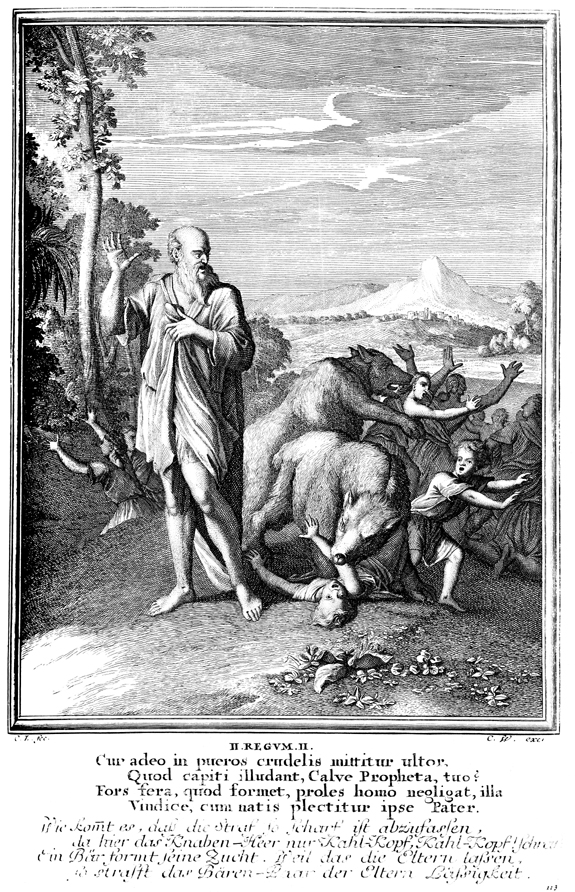 2 Kings 2:23-24: "... as he was going up by the way, there came forth little children out of the city, and mocked him, and said unto him, Go up, thou bald head; go up, thou bald head. And he turned back, and looked on them, and cursed them in the name of the LORD. And there came forth two she bears out of the wood, and tare forty and two children of them."
Sometimes at the copy machine, we find ourselves in the awful predicament of having to fill it back up with paper, because the last person to use the machine did not. In the employee breakroom, the stains on the table suggest that someone ate some barbecue chicken, but did not bother to clean up after himself.
And to make it worse, when passing by two employees, you overhear them gossiping and saying mean things about you, giggling in hushed tones as you pass by.
Quite often, irritation arises with fellow employees because of various reasons; neglect, gossip, etc. This is when we should consider 2 Kings.. 2:..23-..24, when the Prophet Elisha sent two female bears to maul and tear apart 42 children who were making fun of him.Most Christians might ignore this story, saying it has nothing to do with Jesus teachings. This is what is called "cherry picking".
The story of the 42 children being torn apart is a part of the collection books that we Christians call the "inerrant Word of God." And so we must embrace it as truth.
There must be wisdom in this story, and this is it:The next time you hear your constitutuents gossiping about you, or if you know who it was that didn't fill up the copier, or who didn't clean up their mess - ask God to repeat the events of 2 Kings 2:23-24. Put yourself in the sandals of the Prophet Elisha, and remember, as Jesus said in Matthew 21:22, "... whatever things you ask in prayer, believing, you will receive."
Please feel free to forward to as many people as you'd like.
Thursday, August 07, 2008

Time for some Q & A. Someone asked me this question:
What can be used as evidence for what one believes? You say that a christian cannot use a bible to prove their point but a scientist can? If you yourself are still learning then how can you objectively know that you understand religion or anything else as well as you think you do? You used to believe in the bible's teaching and now you look back and feel you were wrong. Then how do you not know that you are wrong now? I find your points through out the topic very intriguing and was just curious as to what is the best way objectively to search for the truth? And for that matter what do you believe truth really is?
Well, the scientific method can be used. But so far, all the times it has been used on religion, it has failed. The biggest experiment on prayer, financially backed by the Templeton group (which is a group that seeks to show religious truth by scientific methods), showed that prayer makes no difference at all.
We can also use the Dead Sea Scrolls, and older manuscripts, that show differences in the Bible as it has been copied over the millenia.
You seem focused on finding an "objective truth". I'd have to say this is physically impossible, given our brain capacity and our having one fixed biological perspective of being the center of the universe (we experience the universe as it enters our senses). We can approximate an "objective truth" only through intellectual honesty. That is to say we must have the courage to call a spade a spade.
The truth is that religion is a failed science. Claims made by religions made sense thousands of years ago because people tried to interpret their experiences and natural phenomena by integrating their superstitions in with their explanations - that's how we get Biblical ideas like the firmament or the "windows of heaven" mentioned in the Flood myth, or the circular (not spherical) earth.
Science shows us that as time goes on, newer information is continually filtered and we are constantly updating what we know about the world. Imagine if humanity decided to be dogmatic about scientific notions and stopped at Newton. Einstein's theories on relativity and gravity, etc. would not be allowed into scientific thought.
Well, in a sense this has already happened with the practice of our religions. Except instead of being stuck hundreds of years ago, we are stuck THOUSANDS of years ago. Now THAT is scary!
What can be used as evidence for what one believes? You say that a christian cannot use a bible to prove their point but a scientist can? If you yourself are still learning then how can you objectively know that you understand religion or anything else as well as you think you do? You used to believe in the bible's teaching and now you look back and feel you were wrong. Then how do you not know that you are wrong now? I find your points through out the topic very intriguing and was just curious as to what is the best way objectively to search for the truth? And for that matter what do you believe truth really is?
Well, the scientific method can be used. But so far, all the times it has been used on religion, it has failed. The biggest experiment on prayer, financially backed by the Templeton group (which is a group that seeks to show religious truth by scientific methods), showed that prayer makes no difference at all.
We can also use the Dead Sea Scrolls, and older manuscripts, that show differences in the Bible as it has been copied over the millenia.
You seem focused on finding an "objective truth". I'd have to say this is physically impossible, given our brain capacity and our having one fixed biological perspective of being the center of the universe (we experience the universe as it enters our senses). We can approximate an "objective truth" only through intellectual honesty. That is to say we must have the courage to call a spade a spade.
The truth is that religion is a failed science. Claims made by religions made sense thousands of years ago because people tried to interpret their experiences and natural phenomena by integrating their superstitions in with their explanations - that's how we get Biblical ideas like the firmament or the "windows of heaven" mentioned in the Flood myth, or the circular (not spherical) earth.
Science shows us that as time goes on, newer information is continually filtered and we are constantly updating what we know about the world. Imagine if humanity decided to be dogmatic about scientific notions and stopped at Newton. Einstein's theories on relativity and gravity, etc. would not be allowed into scientific thought.
Well, in a sense this has already happened with the practice of our religions. Except instead of being stuck hundreds of years ago, we are stuck THOUSANDS of years ago. Now THAT is scary!
Tuesday, June 03, 2008

Roughly all religious testimonies where someone actually claims to have come into contact with a primary source or ’God’ is the same. And I can say that because I’ve heard many testimonies in my life, and I’ve noticed the pattern.
Essentially, the person hits some hard times or some significant event leaves the person with no other option than to give up or surrender.
What happens next is where they make their mistake, because no one really knows what they’re surrendering to, but they sure would like to know.
Usually, they believe they are surrendering to God, and what God is to a desperate individual largely depends on what a person already believes God to be.
And that’s the problem. "God" is a word that carries with it certain baggage, and the word entails different things depending on the context. I’m pretty sure ancient Greeks, when in similar circumstances, petitioned with all their heart to Zeus or even Poseidon. If Hurricane Katrina occurred in ancient Greece, for example, people would’ve been praying their hearts out to Poseidon.
The person who first converted me claimed to have had God speak to him, and so he picked up the Bible and became caught up with its mythos. If you believe the Bible is true, then of course you will wind up believing that the picture that it paints is true. This becomes obvious in the choice of words people use.
A very common thing to say, something that I’ve said myself, is that "The Bible tells us that _________ (fill in the blank) is true" or "Jesus tells us (through the Bible) that __________ (fill in the blank) is true."
The entire statement is built on the assumption that the Bible is true.
I can’t say that I have personally met God, but I have met religion. My brush with religion is largely the experience that most people have. I really don’t think most people who profess to be religious really buy into their own religion. They try to, but they don’t really believe it. This is because most people do not meet face-to-face with a primary source, and are thus prone to doubt. And this is a good thing.
Most people have never seen a convincing miracle. Instead, they are religious because of some perceived social pressure, and thus become religious because of a secondary source.
This secondary source is extremely common and powerful. Church is, after all, important to certain families; it’s culturally important in certain regions; and sometimes it’s just a fun place to hang out. Most people go to church to be around other people.
The trick to not get into this mess, is to not make the first mistake of assuming that religion must be true. When you’ve managed to surrender and you feel that blissful feeling that everything will be okay, don’t run to the Bible or the Koran for answers. While I don’t doubt that when one manages to totally surrender, there is a feeling of bliss and vivid awareness of some sort of presence, we should quickly understand that this is a feeling that people of all religions have felt.
The first mistake comes when the individual gives this feeling of presence a name and subscribes to a background story that simply isn’t true.
And to you people who have never felt the primary source, it would behoove you to be more skeptical toward such claims.
And that’s the problem. "God" is a word that carries with it certain baggage, and the word entails different things depending on the context. I’m pretty sure ancient Greeks, when in similar circumstances, petitioned with all their heart to Zeus or even Poseidon. If Hurricane Katrina occurred in ancient Greece, for example, people would’ve been praying their hearts out to Poseidon.
The person who first converted me claimed to have had God speak to him, and so he picked up the Bible and became caught up with its mythos. If you believe the Bible is true, then of course you will wind up believing that the picture that it paints is true. This becomes obvious in the choice of words people use.
A very common thing to say, something that I’ve said myself, is that "The Bible tells us that _________ (fill in the blank) is true" or "Jesus tells us (through the Bible) that __________ (fill in the blank) is true."
The entire statement is built on the assumption that the Bible is true.
I can’t say that I have personally met God, but I have met religion. My brush with religion is largely the experience that most people have. I really don’t think most people who profess to be religious really buy into their own religion. They try to, but they don’t really believe it. This is because most people do not meet face-to-face with a primary source, and are thus prone to doubt. And this is a good thing.
Most people have never seen a convincing miracle. Instead, they are religious because of some perceived social pressure, and thus become religious because of a secondary source.
This secondary source is extremely common and powerful. Church is, after all, important to certain families; it’s culturally important in certain regions; and sometimes it’s just a fun place to hang out. Most people go to church to be around other people.
The trick to not get into this mess, is to not make the first mistake of assuming that religion must be true. When you’ve managed to surrender and you feel that blissful feeling that everything will be okay, don’t run to the Bible or the Koran for answers. While I don’t doubt that when one manages to totally surrender, there is a feeling of bliss and vivid awareness of some sort of presence, we should quickly understand that this is a feeling that people of all religions have felt.
The first mistake comes when the individual gives this feeling of presence a name and subscribes to a background story that simply isn’t true.
And to you people who have never felt the primary source, it would behoove you to be more skeptical toward such claims.
Thursday, May 22, 2008
 Just an Infidel: My Deconversion Story
I guess I'm an atheist in respect to religion, but not necessarily to God.
Sure, I'm still open to the idea of a God or gods existing, but I know that the concept of God could not be accurately presented from any of the religions we have at our disposal. A personal God as espoused by our holiest books is something I have come to reject. I've even witnessed spiritual phenomena during the course of my life, some might even say supernatural, but fortunately I abstained from attributing these incidents to a specific religion, which is a mistake many people have done.
I grew up in a Catholic home; Filipino Catholics. Most people have heard of the zeal of Filipino Catholics, some of whom will actually go to such lengths as nailing themselves to a cross! I haven't seen such acts in person, but often at a Filipino funeral, someone will lug a huge cross down the church aisle just to get their point across. My mother, however, wasn't steeped in this tradition, and so I wasn't raised by the zealots of the Catholic faith, rather just the moderates.
Later on in my life, at about 14, my father, who is an American of British ancestry (since before the Revolutionary War) converted to Protestant Christianity, and it was through my father that I became acquainted with it as well. The brand of Protestantism that he converted to was Pentecostalism, known for preachers laying their hands on babbling parishioners speaking in tongues, falling onto the ground, and writhing in religious ecstasy.
My first experience with the "laying on the hands" occurred during a youth group session. At the end of his sermon, the youth pastor asked us to come up to the altar and be prayed for. It wasn't long until he began speaking in tongues and tapping people's foreheads. Naturally (or perhaps supernaturally), these normal, boisterous teenagers, began falling down and twitching like epilepsy victims.
I'd also gone up there to pray, but was a bit perplexed by the odd happenings going on around me, though I had heard about this in prior meetings. When the youth pastor started praying over me, I thought I felt a tremor in my knees.
 He then laid his hand on my forehead and blew out a blast of hot air at me. I opened my eyes and looked at him, and he gave me a genuine look of surprise and took a step back. He approached me again and repeated the whole thing all over again. I didn't know what to do, because I didn't really feel like I had to fall down, and he stopped after that, moving on to someone more versed at what to do.
Admittedly, I almost passed out because of his breath, which reeked of halitosis and garlic. We eventually left this church because they began putting too much emphasis on speaking tongues, and were beginning to claim those who don't speak tongues will go to hell. "It's becoming too much like a cult," said my father.
So, we went on to another church that was part of a mainstream Pentecostal denomination, and it was called Calvary Assembly of God. As I had already been acquainted with the intensities of Pentecostal Christianity, all the erratic behaviors I encountered at Calvary were taken in stride. I really "grew in the Lord" at Calvary, became baptized, and began reading the Bible regularly. I was often found with my nose in the Bible, reading as much as I could of it.
I gained some great friends, and we regularly went on field trips, ranging from huge multi-church winter camps up in Lake Arrowhead, or surf trips with the youth group down in San Onofre. We'd become politically active and were involved in numerous pro-life protests and even one anti-gay counter-protest.
We'd regularly witness to complete strangers as well, as the Bible suggested we profess the Good News to all.
It wasn't until my junior year in high school that the first doubts crept in, and by this time I had moved to Lakewood, but would still try to attend church in Lomita as much I could.
None the less, there was a physical barrier of distance between me and the church I had grown to love. My parents divorced, I took my first hit from a joint, I had sex for the first time, got drunk, and other taboos were occurring regularly.
After committing or witnessing each sin, hellfire and damnation still seemed as far away as ever, and yet doing these things actually brought me closer to people, sex of course with my girlfriend at the time, and smoking and drinking with my friends, most of whom I am still in contact with today.
That said, I never really doubted the divinity of Jesus Christ at this time. Rather, it was the doctrine of sin that I began to doubt. How can these behaviors be evil? They were fun, they brought camaraderie, and sex brought on, for me at least, an emotional maturity that I couldn't have had should I have remained a virgin.
Another crack to my system of beliefs occurred while I was in the Navy. While overseas, spinning laps around the Persian Gulf in a brand new, nuclear-powered aircraft carrier, I would sit on the fantail (or the rear of the ship) and ask myself the old chestnut, "Why was I here?"
And not just in the philosophical sense, but also in the social-political sense as well. This line of questioning led me into an inquiry that caused me to question one of the things I had taken granted for so long, and that was that America was an "innocent" country. In 1998, we were still bombing Iraq on a regular basis. It seems that the decade between the first Gulf War and the second was more like a siege than anything.
The United States prevented supplies from reaching the desert nation, and we enforced a no-fly zone, all the while bombing various targets while we were there. This notion of America as the best country or even an innocent one, actually goes hand in hand with my religiosity, as it is in fact a symptom of ethnocentrism. I've learned that the reason that I love America is not because it's the best country, it's just that it's the one I'm the most familiar with, and is the one I have always called home.
After I got out of the Navy, I attended Cypress Community College and it was there that I took my first philosophy class. This class fed some of my suspicions that began festering in the back of my mind. This is where my doubts about the Bible's validity and divinity of Jesus really began to manifest.
Initially, I was a militant agnostic, and was very hostile toward Christianity. It's very much the same as when I first became Christian and became very anti-secular, anti-"other religions", etc. There is an initial fanaticism that occurs each time a new belief sets in.
Around this time, my father went on to become a preacher, and my mother converted to Protestantism as well. My father and I get into some very interesting conversations at times, as one could imagine, but we always engage in these conversations with respect toward each other. We still have these conversations, often when we camp out in the desert.
I never completely gave up spirituality, and so I actually turned to eastern religions for a while. Buddhism in particular drew me in, though I did find Hinduism to be quite fascinating, too. However, Buddhism is steeped in alien mythology, and I decided to extract from it the things I thought made the most sense. Ironically, this is actually advice imparted from Siddhartha Gautama himself.
 In Buddhism, for example, I thought much of the philosophy behind it was quite sound, such as Siddhartha's argument for extinguishing suffering. Meditation, too, is very practical, and can produce amazing spiritual insight. I have also learned through further Biblical research that the Old Testament is just influenced by numerous myths from Sumeria, Babylon, and Canaan, and that these myths were perpetuated by the Israelites, who had come out of these people.
If I were to sum up my personal belief, I'd say the concept of God is kind of like the mirrors placed in the upper corners of markets. They're not necessarily there to help store employees watch a theft; rather they are there to prevent the theft from happening.
When the shoplifter looks up at himself, he sees himself in a third person perspective, and the person he is seeing is a bad guy. Likewise, the concept of God is like an internal mirror.
This isn't even a new idea. Plato called it the form of the Good, Sigmund Freud called it a Super Ego, Christians and Jews call it Yahweh, and Muslims call it Allah. I just call it the "Ideal Self", which we strive to be like, and its standard is set largely by the society or culture we live in.
Similarly, there is a competing force, and this is our physical body's needs and desires. Plato might have called it natural urges, Freud called it the Id, Christians call it the Devil, and Muslims call it Shai'tan. I just call it the Animal Self.
The struggle between the two competing forces is basically the situation we are constantly in. I just drop the supernatural description and see it to be a natural part of being a social animal.
Sure, I'm still open to the idea of a God or gods existing, but I know that the concept of God could not be accurately presented from any of the religions we have at our disposal. A personal God as espoused by our holiest books is something I have come to reject. I've even witnessed spiritual phenomena during the course of my life, some might even say supernatural, but fortunately I abstained from attributing these incidents to a specific religion, which is a mistake many people have done.
I grew up in a Catholic home; Filipino Catholics. Most people have heard of the zeal of Filipino Catholics, some of whom will actually go to such lengths as nailing themselves to a cross! I haven't seen such acts in person, but often at a Filipino funeral, someone will lug a huge cross down the church aisle just to get their point across. My mother, however, wasn't steeped in this tradition, and so I wasn't raised by the zealots of the Catholic faith, rather just the moderates.
Later on in my life, at about 14, my father, who is an American of British ancestry (since before the Revolutionary War) converted to Protestant Christianity, and it was through my father that I became acquainted with it as well. The brand of Protestantism that he converted to was Pentecostalism, known for preachers laying their hands on babbling parishioners speaking in tongues, falling onto the ground, and writhing in religious ecstasy.
My first experience with the "laying on the hands" occurred during a youth group session. At the end of his sermon, the youth pastor asked us to come up to the altar and be prayed for. It wasn't long until he began speaking in tongues and tapping people's foreheads. Naturally (or perhaps supernaturally), these normal, boisterous teenagers, began falling down and twitching like epilepsy victims.
I'd also gone up there to pray, but was a bit perplexed by the odd happenings going on around me, though I had heard about this in prior meetings. When the youth pastor started praying over me, I thought I felt a tremor in my knees.
 He then laid his hand on my forehead and blew out a blast of hot air at me. I opened my eyes and looked at him, and he gave me a genuine look of surprise and took a step back. He approached me again and repeated the whole thing all over again. I didn't know what to do, because I didn't really feel like I had to fall down, and he stopped after that, moving on to someone more versed at what to do.
Admittedly, I almost passed out because of his breath, which reeked of halitosis and garlic. We eventually left this church because they began putting too much emphasis on speaking tongues, and were beginning to claim those who don't speak tongues will go to hell. "It's becoming too much like a cult," said my father.
So, we went on to another church that was part of a mainstream Pentecostal denomination, and it was called Calvary Assembly of God. As I had already been acquainted with the intensities of Pentecostal Christianity, all the erratic behaviors I encountered at Calvary were taken in stride. I really "grew in the Lord" at Calvary, became baptized, and began reading the Bible regularly. I was often found with my nose in the Bible, reading as much as I could of it.
I gained some great friends, and we regularly went on field trips, ranging from huge multi-church winter camps up in Lake Arrowhead, or surf trips with the youth group down in San Onofre. We'd become politically active and were involved in numerous pro-life protests and even one anti-gay counter-protest.
We'd regularly witness to complete strangers as well, as the Bible suggested we profess the Good News to all.
It wasn't until my junior year in high school that the first doubts crept in, and by this time I had moved to Lakewood, but would still try to attend church in Lomita as much I could.
None the less, there was a physical barrier of distance between me and the church I had grown to love. My parents divorced, I took my first hit from a joint, I had sex for the first time, got drunk, and other taboos were occurring regularly.
After committing or witnessing each sin, hellfire and damnation still seemed as far away as ever, and yet doing these things actually brought me closer to people, sex of course with my girlfriend at the time, and smoking and drinking with my friends, most of whom I am still in contact with today.
That said, I never really doubted the divinity of Jesus Christ at this time. Rather, it was the doctrine of sin that I began to doubt. How can these behaviors be evil? They were fun, they brought camaraderie, and sex brought on, for me at least, an emotional maturity that I couldn't have had should I have remained a virgin.
Another crack to my system of beliefs occurred while I was in the Navy. While overseas, spinning laps around the Persian Gulf in a brand new, nuclear-powered aircraft carrier, I would sit on the fantail (or the rear of the ship) and ask myself the old chestnut, "Why was I here?"
And not just in the philosophical sense, but also in the social-political sense as well. This line of questioning led me into an inquiry that caused me to question one of the things I had taken granted for so long, and that was that America was an "innocent" country. In 1998, we were still bombing Iraq on a regular basis. It seems that the decade between the first Gulf War and the second was more like a siege than anything.
The United States prevented supplies from reaching the desert nation, and we enforced a no-fly zone, all the while bombing various targets while we were there. This notion of America as the best country or even an innocent one, actually goes hand in hand with my religiosity, as it is in fact a symptom of ethnocentrism. I've learned that the reason that I love America is not because it's the best country, it's just that it's the one I'm the most familiar with, and is the one I have always called home.
After I got out of the Navy, I attended Cypress Community College and it was there that I took my first philosophy class. This class fed some of my suspicions that began festering in the back of my mind. This is where my doubts about the Bible's validity and divinity of Jesus really began to manifest.
Initially, I was a militant agnostic, and was very hostile toward Christianity. It's very much the same as when I first became Christian and became very anti-secular, anti-"other religions", etc. There is an initial fanaticism that occurs each time a new belief sets in.
Around this time, my father went on to become a preacher, and my mother converted to Protestantism as well. My father and I get into some very interesting conversations at times, as one could imagine, but we always engage in these conversations with respect toward each other. We still have these conversations, often when we camp out in the desert.
I never completely gave up spirituality, and so I actually turned to eastern religions for a while. Buddhism in particular drew me in, though I did find Hinduism to be quite fascinating, too. However, Buddhism is steeped in alien mythology, and I decided to extract from it the things I thought made the most sense. Ironically, this is actually advice imparted from Siddhartha Gautama himself.
 In Buddhism, for example, I thought much of the philosophy behind it was quite sound, such as Siddhartha's argument for extinguishing suffering. Meditation, too, is very practical, and can produce amazing spiritual insight. I have also learned through further Biblical research that the Old Testament is just influenced by numerous myths from Sumeria, Babylon, and Canaan, and that these myths were perpetuated by the Israelites, who had come out of these people.
If I were to sum up my personal belief, I'd say the concept of God is kind of like the mirrors placed in the upper corners of markets. They're not necessarily there to help store employees watch a theft; rather they are there to prevent the theft from happening.
When the shoplifter looks up at himself, he sees himself in a third person perspective, and the person he is seeing is a bad guy. Likewise, the concept of God is like an internal mirror.
This isn't even a new idea. Plato called it the form of the Good, Sigmund Freud called it a Super Ego, Christians and Jews call it Yahweh, and Muslims call it Allah. I just call it the "Ideal Self", which we strive to be like, and its standard is set largely by the society or culture we live in.
Similarly, there is a competing force, and this is our physical body's needs and desires. Plato might have called it natural urges, Freud called it the Id, Christians call it the Devil, and Muslims call it Shai'tan. I just call it the Animal Self.
The struggle between the two competing forces is basically the situation we are constantly in. I just drop the supernatural description and see it to be a natural part of being a social animal.

Wednesday, May 21, 2008

There's a reason there are mirrors high up in the corners of markets, and it's not necessarily what you think it is. They are there because they prevent crime.
No, it's not that they provide an angle that allows the store clerk to see a crime take place, and its not that they are one-way mirrors. When a potential thief sees himself in the mirror, he is more likely not to steal. He sees himself from a third person perspective, and the person he is seeing is the bad guy.
In one social psychology experiment, an experimenter put 150 candies on a table with a sign that said "Take one candy."
After an allotted period of time, and recording how many kids approached the candy bowl while hiding inside the house, the experimenter took the candy bowl and counted how many were taken. He then refilled the bowl with 150 candies but this time he put a mirror behind the bowl. After the allotted amount of time, he took the bowl and counted the candies again.
This experiment has been done repeatedly by psychology students all over the world, and every time the result is roughly the same. With the mirror there, children will usually take only one candy, and without the mirror, they will take more.
To answer the question, "What is God?" I'm going to say it is something of an internal mirror. Freud called it the Superego, Plato called it a Form, Christians call it YHWH, Muslims call it Allah. It is the ideal self, that perfect man or woman we would like to be, and sometimes we even actively strive to be like it.
While we were growing up, we pick up on various social norms like 'stealing is bad' and internalize it into our proper behavior. The social pressure that stems from this becomes our foundation for morality.

There is another force at work here that determines our behavior. Freud called it the Id, Plato might have called it 'natural urges', Christians call it the Devil, Muslims call it Shai'tan. I'll call it the Animal self. Having evolved from animals, we have much of the same basic urges that they do. We have the need for air, food, water, space, and sex. And if we don't get the right amount of these things, we suffer.
And so it is, that we are in a constant tug-of-war between these two things; our higher Ideal Self which proscribes what morality is, and the Animal Self which dictates our physical needs and desires.
Unfortunately, in the material realm, the realm of practicality, it is nearly impossible to be like the Ideal Self, and it is socially reprehensible to be like the Animal Self. Both are essential to our being, and so we find some kind of balance between the two extremes. The balance of the two, the actuality of what we are, has been called many things, but I will call it the Actual Self.
I would like to reiterate that there is nothing new that I'm proposing here. This has been noted many times throughout history and by people of conflicting beliefs. What might be different to you is applying these things to the question of what God is. There is a kind of universal experience that we all share just by virtue of living, thinking, remembering, and interpreting.
Collectively, this amounts to a certain expectation that is put on the individual, and this expectation is reinforced through parenting, by the school system, by our religions, philosophies, culture, and history.
God is the mirror that reflects the sum of all these mental constructions back at the self. God doesn't exist outside of our minds, He exists as a result of them. God is the mental reflection of all the things we think are Good; and His antithesis, call it the Devil, call it the Id, or call it the Animal Self, is the thing we don't want to accept as a part of our selves.
And so we demonize it. We don't want to see it in ourselves.
My suggestion is that we don't have to embrace the Animal Self, nor should we reject it. Rather, we should just understand the Animal Self and accept it. It is an inalienable part of who we are.
Tuesday, May 20, 2008

Most of us should know by now that the ancient Hebrews were pagans, and borrowed their concept of Yahweh from older gods like the Babylonian Marduk and the Sumerian El.
While the mythology of the Babylonians account for most of the worldview of the Hebrews, it is the Sumerian god El from which Yahweh (or YHWH) comes from. Briefly, El was Father of the Gods, Creator of Created Things, The Kindly, Kodesh. El wears bull horns on his helmet and resides at "the Source of Two Rivers" upon Mt. Lel.
El also had a wife named Asherah, who was considered the Queen of Heaven.
In the Bible, we see that Yahweh (the Hebrew's adaptation of El or Elohim) actually had a wife named Asherah. I'm pretty sure that much of the Hebrew's earlier history was lost or forbidden after the reforms of King Hezekiah and King Josiah.
But there are still parts of the Bible that allude to Asherah, especially in complaints from reformist "prophets" like the author of Jeremiah or in the historical accounts of 2 Kings. For instance, the "high places" or "groves" were places where Asherah was specifically worshipped, and she is referred to as the "Queen of Heaven".Check out these Bible verses: Jer. 7:17-18Jer. 44:17Deut. 16:212 Kings 18:4 .
It's strange to think of Yahweh being married. Isn't it?
We can also see how later reforms actually eliminated one earlier concept of god and replaced it with another. First it was the Sumerians and Babylonians, then it was the Hebrews, then it was the reforms of the kings Hezekiah and Josiah, later the various sects that formed out of Judaism, Christianity and its myriad of sects, and finally Islam.
People create and mold the concept of God to suit their needs, political or otherwise, and so religion is forever changing.
Tuesday, July 24, 2007
 I'd like to continue with my argument. Let's examine the flood myth in Genesis. Did you know that there are actually two flood myths being told at the same time? Together, they contradict each other, but when separated they turn into a coherent story.
In one version (J), God instructs Noah to take into the ark two of each unclean animal, and seven pairs of "clean" animals, for a sacrifice after the flood (Gen. 7:3). It says that the flood was caused by rain alone, and it rains for 40 days and nights. Noah then lets a dove out three times to look for land. First, it returns unable to find land. Second, it comes back with an olive leaf, and on the third try it doesn't come back (Gen. 8:8-12).
In the other version (P), God tells Noah to take two of each kind of animal, whether clean or unclean, onto the ark (Gen. 6:19-20). This version was probably a much older version of the flood myth. The cause of the flood is much more grandiose in this one as well, because the "windows of heaven" and the "fountains of the deep" are broken up (Gen. 7:11) ... and the flood lasts 150 days (Gen. 7:24). After the flood, Noah simply sends a raven to look for dry land (Gen. 8:7).
The first version I mentioned is based off a flood myth called "Atrahasis" (the cuneiform tablet above), and the second is based on "Enuma elish". At the end of "Atrahasis", the gods are attracted by the sweet smell of sacrifice and resolve to never again destroy humanity. Now look at Gen. 8:21. There are actually many variants of the flood myth that predate the Biblical account. The Epic of Gilgamesh is written about 100 years before the Bible's account (1100 BCE); Atrahasis has the most parallels with the Biblical account and is dated at about 1640 BCE; and Sumerian Eridu Genesis which dates back 3000 years BCE.
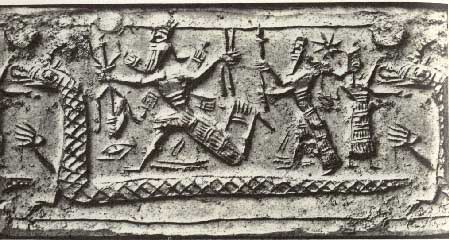
The second version of the flood is based off of the worldview of the "Enuma elish." This is evident because of the idea of heaven's windows opening and the opening of the deep. There was a fairly popular concept amongst ancient people that there was a solid firmament that separated chaos from the Earth. In fact, if we read the Genesis creation account you could see that there is mention of it, and that particular section of the creation account is based on the worldview provided by Enuma elish. Here is an interesting drawing of this firmament concept:
In "Enuma elish", Marduk sets his bow in the sky as a sign that the world order is established. Now look at Gen. 9:12-17, where God (El) sets his bow in the sky. The difference in these two versions is that the bow in "Enuma elish" is the star Sirius, and in Genesis it is a rainbow. However, in both stories the placement of both in the sky marks the final establishment of the earth as a settled place.
 1. Enuma elish - http://www.sacred-texts.com/ane/enuma.htm
2. Atrahasis - Lambert W.G. and Millard, A.R. Atrahasis; the Babylonian Story of the Flood, 1999.
3. http://www.livius.org/fa-fn/flood/flood2-t.html (of interest is the chart at the bottom).
Monday, July 23, 2007
 Here's why I think the God of the Bible doesn't exist. And I'll just focus on one thing. The mythicist position.
The Bible is based off of older mythologies. For instance, and I get this from Tim Callahan's book Secret Origins of the Bible, the Israelites started off as pagans. According to Callahan, the ancient Israelites believed in many of the same gods as the Egyptians and the Canaanites.But as time went on, the mythologies conglomerated and began to be reinterpreted.
We forget that the writing of the Bible spans approximately 1600 years. The Israelites were never a great nation, though they make claims to that in the Bible. It is exactly this reason (that the Bible was written over 1600 years), that there are so many contradictions and inaccuracies in the Bible. Now, people may object to this claim but any reader would see that it takes a certain amount of mental gymnastics and semantic hoop-jumping to make it seem like the Bible isn't contradictory or inaccurate.
But really, it's the story of a cultural transition, from ancient pagan traditions borrowed from neighboring cultures to the consolidation of those into one God. El Elyon, translated as "Most High God", for example, was used by "Melchizedek (above left), the Canaanite priest-king of Salem who sacrificed to him on Abraham's behalf. Christian apologists say that Melchizedek sacrificed to god of the Jews, however that can not be true because "El Elyon" was a god worshipped by the Canaanites. Apparently, apologists later just said El Elyon was a reference to Yahweh.
El (pictured at right) was a sky god, creator and the grey-bearded patriarch of the Canaanite gods." (from Tim Callahan's Secret Origins of the Bible). You know the archaic image we all have of the bearded man in the clouds? That is El. 

But it's not just the Old Testament that is full of ancient mythology, the story of Jesus himself is reminiscent of ancient gods, mirroring elements of stories like Osiris-Dionysus, and others.
The point of my argument is this:
1. Christians base their worldview on the Bible, claiming that the Bible is the inerrant Word of God.
2. Almost all Bible stories, but especially Old Testament ones like the Fall of Man and the Flood Myth are derived from the mythology of surrounding cultures at the time.
3. The New Testament needs these older myths to make sense out of Jesus Christ's death, because the Son of God died for the sins of mankind, who were cursed to be in a sinful state since the Fall of Man.
4. So, the Christian worldview has its foundations built upon old myths.
Friday, June 22, 2007
 The Israelites started off as pagans. According to Biblical scholar Tim Callahan, the ancient Israelites believed in many of the gods as the Egyptians and the Canaanites.
But as time goes on, the Bible began to be reinterpreted. It is very easy when looking at the Bible to think it was all written at roughly the same time. We forget that the writing of the Bible spans approximately 1600 years. The Israelites were never a great nation, though they make claims to that in the Bible.
It is exactly this reason that the Bible was written over 1600 years, that there are so many contradictions and inaccuracies in the Bible. Now, people may object to this claim but any reader would see that it takes a certain amount of mental gymnastics and semantic hoop-jumping to make it seem like the Bible isn't contradictory or inaccurate.
But really, it's the story of a cultural transition, from ancient pagan traditions borrowed from neighboring cultures to the consolidation of those into one God.
El Elyon, translated as "Most High God", for example, was used by "Melchizedek, the Canaanite priest-king of Salem who sacrificed to him on Abraham's behalf. El was a sky god, creator and the grey-bearded patriarch of the Canaanite gods." (from Callahan's Secret Origins of the Bible).
You know the archaic image we all have of the bearded man in the clouds? That is El.
You know the archaic image we all have of the bearded man in the clouds? That is El.
In Isaiah 14:12, it says, "How you are fallen from heaven, O Day Star, son of Dawn! How you are cut down to the ground, you who laid the nations low!"
Gary Lenaire, a former Christian musician from the band Tourniquet, wrote in his book An Infidel Maninfesto, "In Hebrew, Day Star and Dawn are Helal and Shahar. Helal and Shahar were originally Canaanite (pagan) gods, not Satan." Satan is the common reinterpretation that many Christians have today. I imagine Lenaire got this information from Callahan's book as well.
The Jewish people adopted many ancient pagan stories, including the snake tricking the woman in the garden story (Lenaire). That story predates Genesis.
Even the name the Jewish people adopted for their God Yahweh (YHWH or YWVH) was borrowed from other people. Yahweh is the unspeakable name of God, or the Tetragrammaton. Yah was one of the gods worshipped by the Arameans (Callahan), another culture neighboring the ancient Israelites. And Yahweh was originally a part of one of the Canaanite pagan pantheon and worshipped by Canaanite tribes other than the Jews (Callahan).
It makes sense that the Jews would adopt these names into their culture because the Jewish culture was a mixture of many tribes and cultures over many centuries. All the demon and angel names, the names of gods, are from Canaanite, Babylonian, Egyptian, Greek, and Persian deities (Lenaire).
Monday, June 11, 2007
 I thought I'd post this just for the discussion (or disgustion?) value.When I think of cult members (i.e. Moonies, Heaven's Gate, Manson, "Satanic" cults, etc.), two words come to mind: Crazy Fanatics.
The first Christians were, of course, members of a cult, and because of that, I see them as crazy fanatics. And by "crazy fanatics", I mean the guy who would stand on a raised platform outside Jerusalem surrounded by his own feces as a testament to the Lord; or people who would mutilate themselves (usually their genitals) because they thought they sinned (or in the case Aebbe's nuns, to preserve their chastity); or never wash themselves because it was copying the infidels' practice of bathing, or chanting "to kill a Muslim is to do God's will" to passers by.
I would include the Apostles themselves in this group, as they may very well have encouraged this behavior. This was how the early Christians operated. Sure, there may have been some sane ones, kind of like there were some sane Branched Davidians who got out of the compound when they had a chance, but in the end they were your average cult members, like the Mithraists or cult of Isis who'd bathe in blood (washing away sins from the blood of the Lamb sound familiar?).
How can anyone doubt that these people would die for their faith? That's what faith does. It makes it easier to die.

Some early Christians even practiced forms of cannibalism, apparently taking literally "eat of my flesh and drink my blood". This tidbit of information I gleaned from a book called Among the Cannibal Christians by Earl Lee. And don't give me the Protestant copout excuse, "Communion is symbolism, it's just a cracker and some juice!"
Catholics and Orthodox, the descendents of the first church, literally think that eating the bread and drinking the wine is eating flesh and blood ... LITERALLY. Where'd they get that from?
Apparently, the church was formed early enough that there were people who knew the Apostles and these people could just ask them.
"Is this literally the flesh and blood of Jesus?"
And the Apostle's would say, "Yes. This is literally the flesh and blood of Jesus Christ."

Thursday, June 07, 2007

I've given it some thought. Religion, as presented through any holy text, interprets the universe in a similar manner that comic books also present their own universes.

I think arguing within the context of a particular religion is only valid within the universe created by theologians (or religion's authors), not outside in the real world. If I try to say something that is contrary to or alien to what is understood by Christians, for example, it isn't really understood and/or I am corrected by a restatement of that religion. For instance, I might say that there are contradictions in the Bible. The response would be, "Well, you gotta look at the context of the whole thing."
It's kind of like people that study Dungeons and Dragons, Star Trek or Star Wars. If I asked "If Anakin Skywalker, or even Luke Skywalker, were supposed to bring balance to the force, why is it that they only left it either in darkness (Episode 3) or in light (Episode 6), instead of there being an actual balance?"
The reply I'll get when I actually ask this question might be, "If you would've read the books that go along with the Star Wars series, you would've seen that it was actually the son of Leia and Han Solo that would bring balance to the force." Wow! And apparently, this is true, and that's what I mean. Religion is kind of like a comic book or an alternate universe that was created by people, and then others get into it and contribute more to it.
Sooner or later, the people in charge (or the original storywriters) have to authorize certain people who can contribute to the universe (this is what George Lucas did with a few authors of Star Wars books, this is what the Pope had to do when the Catholic Church had to choose which books to keep in the New Testament, and which to throw out).
Anyhow, the difference between religion or a comic book universe is that the barrier that we have to distinguish fiction from reality isn't there anymore. These religions were created so long ago, during a time in which people really were able to believe these things, that of course stories like the Flood were widely accepted then.
Today, however, we have scientific evidence to deter any new religions (though maybe not cults) from appearing again, but we're still stuck with the same old ones. Why? Because they predate modern scientific methods. And because these religion predate modern scientific methods, we are left with the lingering doubt of each religion: "What if they are true?"

Monday, June 04, 2007

Ever hear of Plato's allegory in the cave? To sum it up, imagine that from birth you and some other people lived in a cave with your head and neck restrained by chains so that you are forced to look at the wall in front of you.
Imagine that there is a fire behind you and people walk by carrying different shapes, the shadows of which are cast on the wall in front of you. To you, this would be reality and you would think the shadows are real.
Imagine, after 20 years, you are unchained and brought up to the light for the first time in your life. You would be almost blinded, confused, but eventually your eyes will adjust and you will come to understand your situation.
How would you feel if you were taken back down into the cave again. Would you feel bad about any others who live in the cave and not experienced the light? Would you be able to come back to the position where you occupied before, that the world is shadows and flickering light? If you tried to convince the other people in the cave that there is another world out there of blinding light, would they believe you, having never experienced the things that you tell them?
In this context, Plato, in the allegory of the cave, is talking about the relationship between knowledge and ignorance.

In whichever state we are in, we have become adapted to it and view everything as "reality" from that perspective. No one has knowledge of the state they are in, except when they are in the process of changing it. Another element that Plato introduces is the concept that there is only one way that one can become knowledgeable, as it is impossible to become more ignorant short of brain damage.
I am here, and right now I feel like those in the cave. I think I know what's going on. If someone were to argue with me about an arbitrary subject like the existence of a specific God like Allah or Jehovah, I am confident that I can hold my own. If someone debates politics with me, I have confidence that my position is more reasonable. Most of the time, this is how I feel. However, being in the cave and being in the light are relative positions. After all, it is quite possible I'll experience some enlightenment or acquire new knowledge that will further illuminate my mind.
The acquiring of new knowledge or the experience of a bizarre revelation or a great idea is the only time where a difference is perceived. The new wrinkle in the brain is the same thing as suddenly walking into the light, a mixture of wonder and confusion, followed briefly by the sensation of understanding and wonder.
However, after we become accustomed to this and adopt the new bit of knowledge to the library in our brain, we revert back into the normal condition until the next revelation. But what happens if I am put in the position which I held before the revelation, or around people that believed what I once did?
For instance, I used to belong to a particular religion. After a Philosophy class, I was imbued with knowledge that enlightened me and led me away from this religion. It was simple logic that showed to me that the belief in specific gods was problematic, especially if the God is all-powerful and all-knowing. Now I don't believe that and it has become second nature to do so.
When I am around people of this religious group, I feel alienated and almost sympathetic for them, because to me it is a delusion that they are living with. I even try to explain it to them. This is like the man who saw the light being led back down to the cave again. It is impossible to get back into the same state of mind because a new bit of knowledge had been acquired, mainly that there is an entirely different world out there. And the people whom I try to explain things to, think I am crazy and delusional.
Someone may say that it is possible to know the objective truth, and if we happen to know that truth, we would always be in the right. I'd argue that by saying that we wouldn't really know, because to think we have knowledge is a state that we always occupy until new knowledge comes by and ruins the thought. So, it is best to keep an open mind and heart, and hear out the various explanations of truth, and adopt only those things that ring true.
So, in essence we are all living in Plato's cave, and if we study and seek knowledge always, we will continuously be enlightening ourselves. If we stay where we are intellectually and don't seek knowledge and truth, it will be as if we are in the cave again. I'm not saying that we will become more ignorant, but that we won't become more knowledgeable.

Saturday, June 02, 2007

Roberts said in her book; The Experience of No Self, the moment this happened it felt like a great blowing out, an intense outward leap of the "living flame within". She felt the awesome presence of God, like a feeling of ecstasy. However, after this union with God both the experience of God and the experience of self fell away. In her words, after that blowing out, the world seems "dull" in comparison.
What I got out of reading her book, is that most people's experience of God, the common way that they "feel" God's presence, is really the sense of their desire for God; but not God itself (ding an sich). When our sense of self vanishes, so to does God the concept, the thing of which we desire, dissipate. As a Christian, this was her interpretation of the events. And I'd recommend reading her book, though it is a very rare find indeed.
Buddhists report something very similar when they reach Enlightenment; and so to do Hindus. In fact, Siddhartha Gautama (the Buddha) described his experience under the Bodhi tree in a very similar way as Roberts' attainment of No-Self. It's not a coincidence that mystics in general, of all religions, experience the same thing but refer to it with different words.

When these individual people describe this universal experience, which Sigmund Freud called "the oceanic feeling", they can only describe it in the religion and culture that they are familiar with.
Bernadette Roberts was a Catholic nun, and Siddhartha came out of Hinduism and was starting something different.
Our minds are limited only to the symbols and language it has at its disposal to make sense of the world around it and what it is perceiving. It can only compare its experiences with what it already knows.
I don't care if you're an Apologist, a Flat Earther, a scientist, a Protestant or Catholic, Muslim cleric, or Hindu shaman. We all operate with the same mechanism inside our brain.
We sense side effects of the world around us (light, sound, etc.) and we interpret these things against what we already know.
If it's agreeable, it is incorporated into our system of knowledge. And if not, we either find ways to work around the information in order to continue believing what we believe, or we might change our beliefs, or we'll simply pass it off as nonsense.
This is, of course, unavoidable, but it helps to know that this process is always going on. Our mind is the great Editor; continuously dropping inconsistencies in order to have things fit together.
While stilling the mind and the ego is something that only a few people have done, even these people can only interpret that experience from their own frame of reference.
What is the significance of this? It means that while we can share the same experiences in any religion, we cannot help but interpret that experience as meaning something that confirms our beliefs.

Friday, June 01, 2007

I've got a gripe that I'd like to address.
A few times my in-laws and/or relatives have tried to preach to me. They are used to the type of people who just sit there and nod their heads in agreement, or the majority of people who simply ignore them.
But that's not what I do.
I tell them what I believe, and I believe that their ideas are false and are detrimental to society. I have thought long and hard on my own philosophies in life, and I'm not shy about voicing them. Don't get me wrong, I listen to them. But all too often it is like listening to a skipped CD, the same thing over and over again.
As the wise ones say, "You've got to have faith" is something people tell you so you will believe what they are going to say next.
It seems that because I'm willing to stand up for my own beliefs and oppose their's, I've been labeled by a few of my most pious family members as the Lord of Darkness. Well, they don't call me the "Lord of Darkness", they call me things like "El Diablo" or "The Devil".
Sure, they're my in-laws, and I guess traditionally in-laws aren't always the greatest relatives in the world, but that still makes me feel uncomfortable when I'm around them. It kind of sucks being forced (which I am compelled to do) to pretend being nice to someone (an in-law) who nicknames you El Diablo.
Some of the smiles and hugs given to me, I am sure, have been blessed with holy water and anointing oil. The nickname "El Diablo" would be cool if I really was some bad @$$, but they call me that because
a) I'm not Christian
b) I am able to state why I'm not a Christian, and
c) I can tell them why they shouldn't be one either.
The funny thing is they won't say, "You're the Devil" to me. They say it when I'm not around and then other people tell me what they say. Sometimes, when I am around, they'll say it in hushed tones, and I can definitely hear those. But being somewhat understanding of their position, having been there myself, I simply turn the other cheek. Basically, I just let it slide.
Well, the funniest story of something like that occurring happened last October, and it takes the form of a short and humorous tale:
It was Halloween. The same night that the Celts thought spirits of the dead can enter the realm of the living. I didn't see these spirits as I was stuck in traffic, trying to head to Riverside so I can be with my daughter on her first trick-or-treating adventure. I was, ironically enough, dressed like the devil. Well, I just had horns on and that's it (but they were really cool horns).
For two and a half hours I pressed on through the highways, the sky darkened and the landscape changed from urban to hilly to rural. Obviously, I didn't make it in time to be there for my daughter, and I was really bummed out because she was the main reason for my trek.
My wife informed her mother (in the recent past I've had a few "debates" with her mother, and she wound up getting really angry) before I got there that, "Andy's the Devil." My wife meant, of course, my costume.
And her mom said, "I know ... you're getting tired of his shit, too?"
My wife looked at her mom and said, "I mean his costume. He's dressed as the devil."
I thought that was pretty funny.
Thursday, May 31, 2007


There's a reason there are mirrors high up in the corners of markets, and it's not necessarily what you think it is. They are there because they prevent crime.
No, it's not that they provide an angle that allows the store clerk to see a crime take place, and its not that they are one-way mirrors. When a potential thief sees himself in the mirror, he is more likely not to steal. He sees himself from a third person perspective, and the person he is seeing is the bad guy.
In one social psychology experiment, an experimenter put 150 candies on a table with a sign that said "Take one candy."
After an allotted period of time, and recording how many kids approached the candy bowl while hiding inside the house, the experimenter took the candy bowl and counted how many were taken. He then refilled the bowl with 150 candies but this time he put a mirror behind the bowl. After the allotted amount of time, he took the bowl and counted the candies again.
This experiment has been done repeatedly by psychology students all over the world, and every time the result is roughly the same. With the mirror there, children will usually take only one candy, and without the mirror, they will take more.
To answer the question, "What is God?" I'm going to say it is something of an internal mirror. Freud called it the Superego, Plato called it a Form, Christians call it YHWH, Muslims call it Allah. It is the ideal self, that perfect man or woman we would like to be, and sometimes we even actively strive to be like it.
While we were growing up, we pick up on various social norms like 'stealing is bad' and internalize it into our proper behavior. The social pressure that stems from this becomes our foundation for morality.
There is another force at work here that determines our behavior. Freud called it the Id, Plato might have called it 'natural urges', Christians call it the Devil, Muslims call it Shai'tan. I'll call it the Animal self. Having evolved from animals, we have much of the same basic urges that they do. We have the need for air, food, water, space, and sex. And if we don't get the right amount of these things, we suffer.
And so it is, that we are in a constant tug-of-war between these two things; our higher Ideal Self which proscribes what morality is, and the Animal Self which dictates our physical needs and desires.

Unfortunately, in the material realm, the realm of practicality, it is nearly impossible to be like the Ideal Self, and it is socially reprehensible to be like the Animal Self. Both are essential to our being, and so we find some kind of balance between the two extremes. The balance of the two, the actuality of what we are, has been called many things. But I will call it the Actual Self.
I would like to reiterate that there is nothing new that I'm proposing here. This has been noted many times throughout history and by people of conflicting beliefs. What might be different to you is applying these things to the question of what God is. There is a kind of universal experience that we all share just by virtue of living, thinking, remembering, and interpreting. Collectively, this amounts to a certain expectation that is put on the individual, and this expectation is reinforced through parenting, by the school system, by our religions, philosophies, culture, and history.
God is the mirror that reflects the sum of all these mental constructions back at the self. God doesn't exist outside of our minds, He exists as a result of them. God is the mental reflection of all the things we think are Good; and His antithesis, call it the Devil, call it the Id, or call it the Animal Self, is the thing we don't want to accept as a part of our selves. And so we demonize it. We don't want to see it in ourselves.
My suggestion is that we don't have to embrace the Animal Self, nor should we reject it. Rather, we should just understand the Animal Self and accept it. It is an inalienable part of who we are.
* Just so you know, I am influenced by philosophers like Sam Harris, Simon Blackburn, Plato, and as far as historical materialism goes (but not communism) ... Karl Marx.
No, it's not that they provide an angle that allows the store clerk to see a crime take place, and its not that they are one-way mirrors. When a potential thief sees himself in the mirror, he is more likely not to steal. He sees himself from a third person perspective, and the person he is seeing is the bad guy.
In one social psychology experiment, an experimenter put 150 candies on a table with a sign that said "Take one candy."
After an allotted period of time, and recording how many kids approached the candy bowl while hiding inside the house, the experimenter took the candy bowl and counted how many were taken. He then refilled the bowl with 150 candies but this time he put a mirror behind the bowl. After the allotted amount of time, he took the bowl and counted the candies again.
This experiment has been done repeatedly by psychology students all over the world, and every time the result is roughly the same. With the mirror there, children will usually take only one candy, and without the mirror, they will take more.
To answer the question, "What is God?" I'm going to say it is something of an internal mirror. Freud called it the Superego, Plato called it a Form, Christians call it YHWH, Muslims call it Allah. It is the ideal self, that perfect man or woman we would like to be, and sometimes we even actively strive to be like it.
While we were growing up, we pick up on various social norms like 'stealing is bad' and internalize it into our proper behavior. The social pressure that stems from this becomes our foundation for morality.
There is another force at work here that determines our behavior. Freud called it the Id, Plato might have called it 'natural urges', Christians call it the Devil, Muslims call it Shai'tan. I'll call it the Animal self. Having evolved from animals, we have much of the same basic urges that they do. We have the need for air, food, water, space, and sex. And if we don't get the right amount of these things, we suffer.
And so it is, that we are in a constant tug-of-war between these two things; our higher Ideal Self which proscribes what morality is, and the Animal Self which dictates our physical needs and desires.

Unfortunately, in the material realm, the realm of practicality, it is nearly impossible to be like the Ideal Self, and it is socially reprehensible to be like the Animal Self. Both are essential to our being, and so we find some kind of balance between the two extremes. The balance of the two, the actuality of what we are, has been called many things. But I will call it the Actual Self.
I would like to reiterate that there is nothing new that I'm proposing here. This has been noted many times throughout history and by people of conflicting beliefs. What might be different to you is applying these things to the question of what God is. There is a kind of universal experience that we all share just by virtue of living, thinking, remembering, and interpreting. Collectively, this amounts to a certain expectation that is put on the individual, and this expectation is reinforced through parenting, by the school system, by our religions, philosophies, culture, and history.
God is the mirror that reflects the sum of all these mental constructions back at the self. God doesn't exist outside of our minds, He exists as a result of them. God is the mental reflection of all the things we think are Good; and His antithesis, call it the Devil, call it the Id, or call it the Animal Self, is the thing we don't want to accept as a part of our selves. And so we demonize it. We don't want to see it in ourselves.
My suggestion is that we don't have to embrace the Animal Self, nor should we reject it. Rather, we should just understand the Animal Self and accept it. It is an inalienable part of who we are.
* Just so you know, I am influenced by philosophers like Sam Harris, Simon Blackburn, Plato, and as far as historical materialism goes (but not communism) ... Karl Marx.
Wednesday, May 30, 2007

I've been having an ongoing discussion with someone about creationism. He thinks it is a valid scientific theory that can replace evolution. After a while, I realized that he doesn't know what evolution is. Here is the tail end of that conversation. Tell me what you think.
Creationist writes:
I have no problem with adaptation, THIS NOT PROOF OF EVOLUTION. This old trick is called equivication, and the writing of dawkins is full of it. (i mean that on more than one level too) He shows some examples of adaption, then goes on to qualify it with evolution. This IS NOT science, its clever guerilla ontonlogy.
Creationist writes:
I have no problem with adaptation, THIS NOT PROOF OF EVOLUTION. This old trick is called equivication, and the writing of dawkins is full of it. (i mean that on more than one level too) He shows some examples of adaption, then goes on to qualify it with evolution. This IS NOT science, its clever guerilla ontonlogy.
The kind of adaptaion that he assumes can occur, where lizards grow feathers and wings, is evolution, the praying mantis species that can develop wings (it being a part of its natrural design, like adaption) and then lose them again through subsequent generations, is adaption, the kind of thinking needed to proove, monkeys to man is unprovven EVOLUTION THEORY.
I am surprised you haven't noted the difference, and therefore have realised that perhaps we better qualify semantics before every discussion, i thought we had (or are you just applying the same strategys as these authors you seem to admire??) been through this in the past.
I am surprised you haven't noted the difference, and therefore have realised that perhaps we better qualify semantics before every discussion, i thought we had (or are you just applying the same strategys as these authors you seem to admire??) been through this in the past.
Scam responds:
Well, I think I see the problem here ... or at least one of them. It is the word "theory". If a
 scientist acquires a large body of data, and if this data coheres with a working theory ... than the theory is a working and highly probable theory.
 If I drop a penny a million times, and it actually drops to the ground. I can conclude that there is some sort of force that pulls things toward the Earth. I can then go about measuring different ways in which that force pulls different weighted objects, etc.
I can put all that data, including the simple dropping a coin a thousand times, into a working theory of gravity. It might change, mind you. Maybe some other, more sophisticated scientist, will discover that all matter can bend space around it and this curvature is what causes things to fall toward it.
Likewise, a naturalist notices that humans can create new species via domestification. If you look at a banana, for example, you'd find it indistinguishable from a wild banana ... which is full of seeds, hard to eat, etc. It took maybe hundreds of years to cultivate a banana so that it can reliably produce the type that we are familiar with today. The guy's arm hair in the above picture is also quite fitting for the explanation I am going to make.
If humans can cause this radical change in animals and plants to make them useful for humans ... than ... in a natural way, animals and plants unknowingly change over time to adapt to different climates and environments. I think you can agree with me that nature is much more grander than man is.
And though the workings of nature in general are not at all similar to the purposes of a single species like man ... it does follow that nature could still bring about these changes, and we can see its effects through natural section. Natural selection is generally agreed upon by all people, even by creationists, who like to call it microevolution.
If we are to accept geology, chemistry, astronomy, and physics ... and we should, we should at least come to the conclusion that the universe is, if I remember correctly, something like 18 billion years old, and that the Earth has been around for at least a couple billion years. Please note that these facts are agreed upon by all sciences. Fossils of creatures show up fairly recently at a few hundreds of million years and these are fairly simple single-celled organisms.
But as we look at more recent times in the geologic column the animals generally get more complex because of environmental changes, etc.
Everyone accepts the idea of natural selection, because it has been noted and recorded within the past few hundred years. Almost everyone, but most importantly scientists, also accept that life started a few hundred million years ago because of a uniform location in the geologic column.
It is only plausible to connect the two and say that natural selection also occurred hundreds of millions of years ago. During that HUGE span of time, natural selection has naturally created the animals that we are familiar with today.
We need only look at the fossils we've been able to collect, those few creatures that died in conditions that preserved their remains over the years, and we can see their relation to creatures that exist today.
Thursday, January 12, 2006
A lot of people don't like gangsta rap, and to tell you the truth, neither do I.
However, the real reason we hate it is because it actually reminds us of our society.What do we think about when it comes to gangsta rap? What is our most common criticism of gangsta rap?
It's the degradation of women with the 'bitches' and 'hos' comments, it's the love of money and objects, it's violence from one individual ego to another, and to make it worse, almost all of the gangsta rappers are black. Let me spell this out real carefully.
Our nation was founded upon some really obvious injustices. We live in a patriarchal society, where men are taken more seriously than women and are generally thought of (and officially are) the authoritarians in society. All our presidents have been men up to this point, fathers stereotypically "bring home the bacon", "a man's home is his castle", you know what I mean. We live in a society dominated by men.
The gangsta rapper reflects this with his lyrics, relegating all women to mere 'bitches' and 'hos'.We live in a capitalist society, where money is god. We get all worked up about our cars (are they clean, what kind of cars, etc.), our homes, and acquiring STUFF. Shopping is a favorite pasttime because the goal is to GET MORE STUFF. We are very materialist, just like the gangsta rapper.We worship the individual.
Somehow the concept of "I" becomes more important than we. I can think of numerous examples of one person not liking another simply because some trivial ego conflict ("There's just something about him that I don't like"). In that way, we too are like gangsta rappers. (Let's shoot this guy because he lives over there). Not to mention that we also live in a culture of violence, where there is a tendency to believe that "might makes right".
What makes it worse, however, is that gangsta rappers are black. Another fundamental institution this country was founded on is racism. You see, it's not just WHAT these rappers are saying that is so repulsive (and it is), it's also WHO they are.
If you think about it, gangsta rappers are just a reflection of a white supremacist, capitalist patriarchy (thank you bell hooks), and they are black.
However, the real reason we hate it is because it actually reminds us of our society.What do we think about when it comes to gangsta rap? What is our most common criticism of gangsta rap?
It's the degradation of women with the 'bitches' and 'hos' comments, it's the love of money and objects, it's violence from one individual ego to another, and to make it worse, almost all of the gangsta rappers are black. Let me spell this out real carefully.
Our nation was founded upon some really obvious injustices. We live in a patriarchal society, where men are taken more seriously than women and are generally thought of (and officially are) the authoritarians in society. All our presidents have been men up to this point, fathers stereotypically "bring home the bacon", "a man's home is his castle", you know what I mean. We live in a society dominated by men.
The gangsta rapper reflects this with his lyrics, relegating all women to mere 'bitches' and 'hos'.We live in a capitalist society, where money is god. We get all worked up about our cars (are they clean, what kind of cars, etc.), our homes, and acquiring STUFF. Shopping is a favorite pasttime because the goal is to GET MORE STUFF. We are very materialist, just like the gangsta rapper.We worship the individual.
Somehow the concept of "I" becomes more important than we. I can think of numerous examples of one person not liking another simply because some trivial ego conflict ("There's just something about him that I don't like"). In that way, we too are like gangsta rappers. (Let's shoot this guy because he lives over there). Not to mention that we also live in a culture of violence, where there is a tendency to believe that "might makes right".
What makes it worse, however, is that gangsta rappers are black. Another fundamental institution this country was founded on is racism. You see, it's not just WHAT these rappers are saying that is so repulsive (and it is), it's also WHO they are.
If you think about it, gangsta rappers are just a reflection of a white supremacist, capitalist patriarchy (thank you bell hooks), and they are black.
Subscribe to:
Posts (Atom)