A nonbeliever's SECOND reading of the Bible

A nonbeliever's SECOND reading of the Bible
Hunc tu caveto.
Powered By Blogger

Wednesday, March 24, 2010


Deuteronomy's Chapters 19 through 21 deal with what sort of killing is okay in the eyes of Yahweh.

Dealing with the Difference Between Murder and ManSlaughter

Chapter 19 is a sort of amendment to the Sixth Commandment: Thou shalt not murder.

First, anyone that kills his neighbor should be executed. Specifically, he ought to be killed by the victim's closest relative, whom the ancient Hebrews called 'the avenger of the blood'.

If he accidentally kills someone, then the accidental killer must flee to another city. But, if he returns to the city where the victim lived, then the 'avenger of the blood' may kill the guy.

However, before determining this there should also be three witnesses.

Killing in the Context of War

Deuteronomy, Chapter 20, if I can sum it up, says that first of all the Hebrews should not be afraid in battle because Yahweh has their back.

The chapter makes a distinction between two types of foes: distant enemies that are too far to be conquered, and nearby enemies that can be incorporated into the Israelite nation. Upon defeating distant opponents, Israelites should slay all the males but take for themselves all the cattle, children, and women for themselves.

But closeby cities, which Yahweh has essentially given to the Israelites, are to be utterly destroyed. Yahweh instructs the Israelites to kill all the lame, sickly, and elderly people; but to take young women and children.

In fact, as Chapter 21 explicitly says, if you find a beautiful woman among the captives, take her into your house, shave her head, let her mourn her dead parents, and then "go in unto her".

An ancient Israelite can even have two wives: "one loved, and one hated."

When Punishment Deserves Death

Chapter 21 even talks about what sort of infractions deserve death.

In particular, any child who is disobedient, and I mean thoroughly disobedient, then he should be taken to outskirts of the village and stoned to death by the villagers.

And if the punishment is hanging, the advice given by the author of Deuteronomy is that the person should be taken down before the end of the day. Apparently, the criminal who was hung is so vile that if he remained on the tree for more than one day, his vileness would contaminate the land.

Monday, March 22, 2010

Sam Harris talks about how science can, and should, be an important factor of morality.


Thursday, March 18, 2010


In my many conversations with apologists, Bible thumpers, and the extremely pious; I've found that the most effective way to "win" starts off by showing that the argument for a) the existence of god, and b) the god they believe in, require completely different proofs. Former apologist John Loftus writes about it in his blog 'Debunking Christianity' as well. Numerous nonbelievers, like Sam Harris, successfully use the same strategy.

The Proof for Deism

Arguing for the existence of god is called "natural theology", or deism. This god relies on gaps in scientific knowledge. We should have no problem on a practical level with this. Until those gaps are filled, this god will always exist. So, arguing against deism is basically useless because either way it won't matter.

The Proof for Christianity

But Christianity is something completely different. Christianity does not rely on gaps in scientific knowledge. It relies specifically on whether the Gospel accounts of miracle stories attributed to Jesus are true. Just establish this obvious distinction first.

Soon, I will place another post up for the next step, which is simply the basic argument for why we should reject Christianity. But if you want to watch a short version of it, here's how Sam Harris did it at the La Ciudad de las Ideas debate earlier this year.

Tuesday, March 16, 2010


I just read Deuteronomy, Chapters 17 and 18. Again, we are covering ground that has already been covered. And in some cases, we're covering ground that I'm not sure should be covered.

The lessons I've learned in Chapter 17 are:

  1. Kill people who deconvert or follow other gods.
  2. Don't sacrifice animals with blemishes.
  3. When being judged by a priest, I must follow his judgment and if not I will be executed.
  4. When under the power of the king, the king should not have multiple wives.
  5. The king should also not have too much money.
In Chapter 18, I learn the following:

  1. The Levite priests can't own land, and must live off the offerings of the other tribes.
  2. Sacrifice the firstfruit of my crops and my livestock.
  3. Anyone that practices witchcraft (unless it's magic from Yahweh, of course) is an abomination to Yahweh.
Chapter 18 is also interesting in that there is a prophecy in there: Yahweh says, "I will raise them up a Prophet from among their brethren, like unto thee, and will put my words in his mouth; and he shall speak unto them all that I shall command him."

So, Yahweh plans on sending prophets. He also warns against false prophets. Unfortunately, the only way to tell the difference is if their words come true. And if they don't, they are to be executed.

Being a Prophet is serious business for the ancient Israelites.

Wednesday, March 10, 2010

Deuteronomy Chapter 16 - In this chapter we are reminded about some of the special holy days set aside by the ancient Israelites. In particular, there are three great festivals in which Jews and Israelites should meet at the temple and celebrate.

The Feast of Unleavened Bread is celebrated during the month of Abib, which is a month in the Hebrew calendar. It's to remind the Israelites about their escape from Egypt. In 16:3 it says that you must eat unleavened bread for seven days; and in 16:8 it says six days, so I'm not sure what that's about.

The Feast of Weeks is meant for the entire community of ancient Israelites, and it is to remind them that their people were once bondsmen of Egypt.

In this chapter, it's not clear what The Feast of Tabernacles is about, but elsewhere on the web it says it's agricultural in origin.

During these festivals, or holidays, the males of the tribe must present themselves before Yahweh, and give a generous donation to the priesthood.

I'm not sure why it's in there, but at the end of the chapter (16:16), it almost sounds like judges and officers are picked during these festivals as well.

It's an interesting chapter and there's nothing too controversial. It's actually interesting to learn about the holidays of other cultures as well.

Tuesday, March 02, 2010


Deuteronomy Chapter 15 tackles the troubling issue of poverty and slavery. I think it has some nice things to say about poverty.

15:7 says, "If there be among you a poor man ... thou shalt not harden thine heart, nor shut thine hand from thy poor brother."

And 15:11 says, (15:11)"Thou shalt open thine hand wide unto thy brother, to thy poor, and to thy needy."

Yes. That's great advice! It still sounds good to this very day. Would you agree?

And then there's slavery.

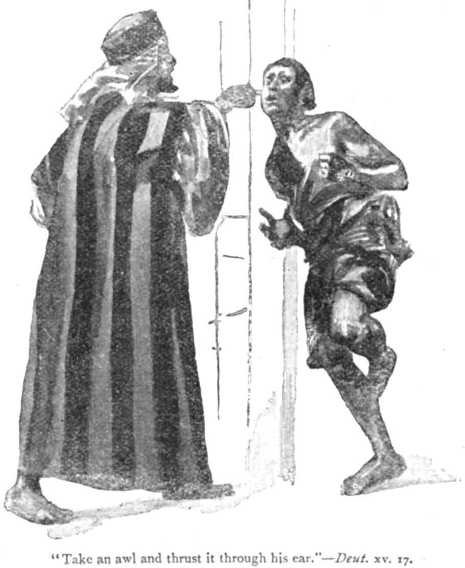
15:12-17 says, "If thy brother, an Hebrew man, or an Hebrew woman, be sold unto thee.
and serve thee six years; then in the seventh year thou shalt let him go free from thee. And when thou sendest him out free from thee, thou shalt not let him go away empty: Thou shalt furnish him liberally out of thy flock, and out of thy floor, and out of thy winepress: of that wherewith the LORD thy God hath blessed thee thou shalt give unto him. And thou shalt remember that thou wast a bondman in the land of Egypt, and the LORD thy God redeemed thee: therefore I command thee this thing to day. And it shall be, if he say unto thee, I will not go away from thee; because he loveth thee and thine house, because he is well with thee. Then thou shalt take an aul, and thrust it through his ear unto the door, and he shall be thy servant for ever."

Basically, after a slave's seven year term, hook him up and be generous to him as he parts ways. If he/she wants to stay with you, drill a hole through his ear into a door and he'll be your servant for life.

Judging from a modern-day perspective, more than 2,000 years later, a perspective with the hindsight of the Civil Rights era, the American Civil War, and the various practices of slavery before then; slavery has been a big moral issue for humanity. It's still a big issue today; and the arguments even delve into what is called wage slavery - which is basically what everyone calls "working". Anytime another human's labor is owned, and not purchased in any way, that raises the question of slavery and whether it is moral.

But 3,000 years ago when Deuteronomy was written, nobody in ancient Israelite society had these conversations (or at least published them).

So I ask you, the reader, this: What is it that makes it possible for people today to pick up the Bible, read Deuteronomy Chapter 15, and see that one set of passages are moral, and another set isn't?

Monday, February 22, 2010

Dennis,

Click here

Out of sheer coincidence, nonstampcollector just put this up today and describes what I'm trying to explain to you in cohesive manner.

Deuteronomy, Chapter 14 is instructions on how to create an ancient Israelite restaurant.

But first - a bit on how restaurant staff should look. Sorry emo people, God doesn't want you to cut yourself. And you guys and gals with uni-brows, you can't shave them! And you DEFINITELY can't do neither for the recently deceased!

Another important distinction to make about the Bible is to not take its scientific claims seriously, like in 14:7 where Moses instructs the Israelites not to eat "the hare, and the coney: for they chew the cud."

Just an FYI, rabbits don't chew their cud. They eat, poop, and then eat their poop, which is what they digest.

So yes, no rabbits on the menu! And no sea creatures that do not have fins or scales (i.e. mussels and clams). And there's a whole litany of birds that will not be on the menu; they're mainly predatorial birds like eagles and pelicans; but there's also those pesky swans and bats. Bats!?! Yes, the ancient Israelites had no concept of grouping animals by mammalian characteristics. At least, there methodology wasn't sophisticated enough to tell a flying mammal from any other bird. To them, animals were grouped by flying and nonflying, divided hooves or not, sea creatures with scales and fins and those that didn't; and 'clean' and 'unclean'.

The ancient Israelites didn't necessarily think these animals were dirty. By 'unclean', they were either talking about whether the animals was fit for animal sacrifice; and that is usually determined on whether the animals fit neatly into their primitive methodology of categorizing the world.

Also on the menu is roadkill, or any dead animal found laying around. Ancient Israelites couldn't eat these things because they weren't ritualistically cleaned when the animal died (they weren't 'kosher'), but they were instructed to have no qualms about selling this to outsiders. I wonder, if there was such thing as an Ancient Israelite restaurant, would the waiter tell the infidel guests that the food they were eaten was from an animal they found lying in the street?

Oh yes, and don't ask for a baby goat to be boiled in its mother's milk. They don't do that!

Friday, February 12, 2010


"If there arise among you a prophet, or a dreamer of dreams, and giveth thee a sign or a wonder ... that prophet, or that dreamer of dreams, shall be put to death." Deuteronomy 13:1-5

Under this law alone, many people would have been put to death. John Lennon, Spinoza, Isaac Newton, Moses, Jesus ... all guilty of being either a prophets and dreamers if judged from the eyes of the ancient Israelites. Luckily, these eyes are long closed.

Deuteronomy, Chapter 13 is a sermon to the Israelites on the evils of new ideas, aka heresy.

A few verses later (13:6-10) Moses spells it out clearly: ""If thy brother ... or thy son, or thy daughter, or the wife of thy bosom, or thy friend, which is as thine own soul, entice thee secretly, saying, Let us go and serve other gods ... Thou shalt not consent unto him ... neither shall thine eye pity him ... But thou shalt surely kill him; thine hand shall be first upon him to put him to death, and afterwards the hand of all the people."

Today of course, we ignore all of Moses' advice in this chapter, but I must ask you. If the Bible is a manual for morality, what is it that causes us to ignore this verse but find wisdom in a verse like that in Leviticus that says to "Love your neighbor."?

Wednesday, February 03, 2010


Destroying Altars


Okay, I was a bit misleading last time. Yahweh doesn't ask the Israelites to drink the blood of animals, rather he asks them to a) sacrifice an animal, b) pour the blood out all over the altar, and then c) eat the flesh. Satan probably wasn't invented yet, but Satanists (the devil worshipping kind, not the 'atheist' kind) today might recognize the ritual as one of their own.

Moses also instructs the Israelites to go out and completely destroy the altars and groves of the nations surrounding them. He's basically trying to shore up Yahweh as the only god for the Israelites. This violent backlach against other religions suggests that these other religions were a bit of a problem for the budding Yahwists. It seems feasible at least that at least a few Israelites were a little too interested in the religions of their neighbors, and the political infrastructure of Israelite society wanted to stop this curiosity.

In the words of Moses (Deuteronomy 12:30), "Take heed to thyself that thou be not snared by following them, after that they be destroyed from before thee; and that thou enquire not after their gods, saying, How did these nations serve their gods? even so will I do likewise."

Moses then brings up the human sacrifices of their neighbors as a reason not to follow them. Which is odd, because this is the same society that has no problem executing disobedient sons, women who had sex before their wedding day, and killing the children of the nations they conquer (or should I say, "happily dashes the little ones on the rocks?).

I'm getting this weird picture here. And it goes soundly with the principle that "History is written by the conquerors." The Israelites were a sort of rogue militaristic nation amongst many other similarly cultured Sumerian/Canaanite nations. It was the Israelites who had the strongest drive to go out and conquer their enemies. These other nations didn't put up a very good resistance either.

Some might say it's because Yahweh was on their side. I'd have to disagree. It might've 'seemed' like Yahweh on their side, in the same sense finding an empty parking space in front of Walmart might seem like God reserved it just for you. But I think the Israelites were just a lot more organized then their neighbors. They had a great propaganda machine going on. And they probably had a charismatic leader. Then again, it's also quite likely that a lot of this is early stuff about Israel is legend. Many scholars don't even think Moses was real; but I'm sure that some cult leader was responsible for the upstart religion/nation.

A lot of what is said in the Book of Numbers and most of the Pentateuch isn't supported by archaeology, either. The places might correspond, but the events as they are recorded in the Bible don't match up (like millions of people wandering the wilderness).

Anyways, the Israelites continue to have problems with other religions until the later 'reformist' kings begin their rule. Right now, Deuteronomy is trying to describe a time when the Israelites were just getting a foothold in the region.

Next time, we'll discuss why Yahweh nor the Israelites would not have liked John Lennon much.

Friday, January 29, 2010


Hindsight is 20/20, and if I was in the crowd whom Moses is talking to in Deuteronomy 11, and knew what I know now, I'd have to call Moses out on his b.s. Of course, I'd probably be stoned for blasphemy, too.

Chapter 11 is basically an appeal to the Israelites, and it can be summed up real quick. Follow these commandments that I give you; and you will be blessed. Don't follow them; your life is going to suck.

Even if I'm trying to be sympathetic to these guys in the Old Testament, I can't. It's just so easy to see through their facade. This is really just politics of fear. "If you're not with us; you're against us."

But that's cool, I have read this in the past, but not as critical. Now, as I read the Bible I am increasingly amazed that people think this is the "greatest book of all time," especially when it is most emphatically NOT. Shakespeare is better than this. Hell, reading Hegel's ramblings on the Zeitgeist is better than this!

But still I trudge on. Next time, Yahweh asks the Israelites to drink blood during their sacrifices.

Sunday, January 24, 2010

You can Digg my blog, but can you get your Facebook out of Myspace, You ... TUBE!

Friday, January 22, 2010


I've mentioned before that Deuteronomy is a collection of sermons from Moses to the Israelites.

Deuteronomy, Chapter 8 is a reminder to the Israelites that if they forget Yahweh for what He has helped them achieve, then He will chastize them.

As the closing sentences say, "And it shall be, if thou do at all forget the LORD thy God, and walk after other gods, and serve them, and worship them, I testify against you this day that ye shall surely perish. As the nations which the LORD destroyeth before your face, so shall ye perish; because ye would not be obedient unto the voice of the LORD your God."

Chapter 9 is a sort of pep rally to the Israelites just prior to invading other lands. Moses warns the Israelites of "nations greater then their's" and of even MORE giants! But they shouldn't fear, because they have Yahweh on their side, and the Ark of the Covenant, and they shall surely prevail.

Moses justifies their invasion. I paraphrase this, but I encourage you to the chapter for yourself. "It's not for our own pride or for our own benefit, but because these nations are an affront to Yahweh, and it is only through their destruction that Yahweh can deliver on his Holy promise of delivering them to their land of milk and honey."

Moses reminded the people about how they have strayed. "While I was up on the Mount for 40 days and 40 nights, eating only bread and water, and Yahweh was writing His commandments, you were down here worshipping an idol of Ba'al, and corrupting yourselves! Yahweh wanted to destroy you then, but I interceded and convinced Him not to do so."

In Chapter 10 Moses continues his historical narrative, basically reminiscing on the how the ark of the covenant was created. He sort of takes the credit for building the ark. But if we look back in Exodus 37:1, it's a man named Bezaleel. Moses also seems to get it wrong about the death of Aaron and where he was buried. In Deuteronomy, Aaron was buried in a place called Mosera; but in Numbers Aaron was buried on Mount Hor.

Moses closes chapter 10 with a series of problematic statements. He says that the only requirement he asks of the Israelites is that they fear Yahweh, to keep His commandments, and to remember that the heavens and the earth belong to Him. We should be kind to strangers, praise Yahweh because he is above all other gods, and we should swear by His name.

There's so many technicalities on that little bit. Depending on where you read in the Bible, the Earth belongs to either God, humans, or the devil. Being kind to strangers isn't necessarily a Judeo-Christian trait if you've read the Bible. And of course, we're not supposed to swear by the name of this particular god.

We see here in these chapters that Yahweh can be reasoned with, if we stroke His ego. Wait. Isn't that the key to all Abrahamic religions? Isn't that what Jews, Christians, and Muslims say that the whole purpose of life is? It's to worship. It's to stroke the ego of Yahweh, or Allah. Worship is that, and it is also a surrender to God. Right?

I remember when I was a Christian. The words I spoke were meant to stroke the ego of God, but the experience in so doing was a surrender. There's nothing wrong with the surrender, per se. It's the context of how we do it that is problematic. The surrender is an experience that can be had by all humans. Surrendering of course, leaves us in a vulnerable state. The words that we say in this condition, be it "Praise Jesus", "Hare Krishna", "Om nama shivaya" or "Allahu Ackbar" are utterly separate from the experience itself. It is only afterward that we internalize the meaning of these words. We somehow attribute their implications to the spiritual experience itself. If you don't believe me, try it yourself.

So, in the words of Moses, "Don't be so stiff-necked and proper. Rather, circumcise the foreskin of your heart." (Deuteronomy 10:16) :)

Tuesday, January 12, 2010

Above: Hey, they were only doing what they thought God wanted them to do.


I like Deuteronomy, Chapter 7. There's so many things wrong with it - historically, intellectually, and ethically. There's even a little bit of prophecy in there.

Yahweh's prophecies were that 1) the Israelites will conquer seven great nations (Canaanites, Amorites, etc.), and 2) that the Israelites (and their cattle!) will NEVER become infertile. Later on, in Joshua, we find that the Yahweh was simply unable to deliver on the first prophecy. And of course, people of Hebrew descent have the same rate of being barren as any other human.

Historically, this chapter implies that there was more than 20 million people in the region at this time. The archaeological evidence does not support that at all. In fact, anyone that thinks the Bible is inerrant is just plain wrong.

Intellectually, there are a few contradictions:

1) Yahweh tells the Israelites not to intermarry with these other tribes. Moses, of course, is an exception.
2) Yahweh also instructs the Israelites to kill strangers; but a few chapters later in Deuteronomy 10, Israelites are asked to be kind to strangers "because they were strangers in Egypt."

And ethically, this chapter is just a nightmare. It advocates:

1) The killing of strangers who worship a different god.
2) Killing all of the inhabitants (including women and children) of the lands they conquer.
3) Intolerance (don't intermarry, destroy relics of the other people's religions, etc.)

So, that's Chapter 7 in a nutshell. I wonder what an apologist would say? That it's okay in that cultural context and that time period?

Monday, January 04, 2010

Above: An image from www.thebricktestament.com, a young man posts the Law on his gates to keep the Law strong in Israelite society.


After going over the Second Commandment in Chapter 4, Moses reviews all of the Commandments in Chapter 5, and then in Chapter 6 he talks about how to keep the law going. This is basically what Deuteronomy seems to be: a series of sermons from Moses to the Israelites. It's like the pastor's playbook.

In the first three chapters, they reviewed their time in the wilderness. More information was added to it then in Exodus and Numbers. They fought a lot of giants, and conquered off a lot of Canaanite tribes, for example. Now, Moses is reviewing the Commandments with a little more depth, and it's written more like a sermon.

"... when ye heard the voice out of the midst of the darkness, (for the mountain did burn with fire,) that ye came near unto me, even all the heads of your tribes, and your elders ...", sounds like Moses is talking directly to people.

And I think I've already laid out the problems with the Ten Commandments (i.e. women are property, it's okay to own slaves, punishment doesn't fit the crime, etc.).

Chapter 6 is another sermon from Moses, and it is about how to keep the law going strong in Israelite society: which is basically to remind everyone about it and keep talking about it. It sounds like something the Communists were famous for, and what EVERY society does: good ol' fashioned propaganda.

Except, instead of talking about the revolution, or democracy, or freedom; the Israelites were concerned about keeping the Law. What steps did they take? Here's the rundown:

1. Teach it to the children.
2. Talk about it in the privacy of your home or out in public, when sitting, lying down, or standing up.
3. Bind copies of the Law to your hands and on your head.
4. Put it on door posts and to the gates of your house.

Perhaps the last two seem extreme, but we've seen it. The Red Star or the American flag hat; the Che Guevara poster on the wall. The Israelites can be said to have been the first people to record this behavior.

Next time, we discuss bad archaeology in Old Testament.

Tuesday, December 22, 2009

If the Commandments were in order of importance, this would be the second most immoral thing you could do.

Deuteronomy, Chapter 4 - once again Yahweh brings up the Second Commandment. "When thou ... make a graven image, or the likeness of any thing, and do evil in the sight of the Lord, you shall perish upon the land and be utterly destroyed."

I'm trying to understand this irrational paranoia about the graven image. While I'm convinced the punishment is ridiculous, I kind of understand what the authors were trying to get at. A graven image isn't the thing itself, or the 'ding an sich'. It's merely a representation of something.

So, a drawing of a bird, for example, is nothing more than a manmade representation of a bird. It's obviously not the real thing. Apparently, to the ancient Hebrews, this was a problem.

Since they were the descendents of Sumerians and Canaanites, it's quite likely that a lot of Israelites still held on to the beliefs in other gods within the Sumerian/Canaanite pantheon. And they probably had a lot of idols to represent each of these gods. The Israelite priesthood, who was really trying to get this Yahweh thing off the ground, decided that the best way to deal with this was to ban graven images entirely.

The Catholic Church, a 1000 years later, approached the subject with a different strategy. Instead of banning idols, they simply incorporated their own images to substitute the idols of various barbarian tribes. The Catholic saints are usually the replacement of various pagan gods. For example, St. Nicholas replaces the Greek god Poseidon.

I'm inclined to believe that the Catholic Church's tactic was a little more successful. It incorporated more people, and it didn't alienate them at all.

Tuesday, December 15, 2009


In Deuteronomy, Chapter 3, Moses and his band of Israelites take on yet ANOTHER giant! This time, he's the king of the Bashanites; a man named Og.

While his name sounds like he's nothing more than a primitive caveman, and his nation sounds like a violent gang (the Bashingites?), Og is apparently the last of the race of giants. I think that's the Israelite priests' gimmick; portray Moses as the Giant Slayer.

Sure enough, we get another wonderful pearl of wisdom in Chapter 3: "And we utterly destroyed them, as we did unto Sihon king of Heshbon, utterly destroying the men, women, and children, of every city. And we utterly destroyed them ... utterly destroying the men, women, and children, of every city. But all the cattle, and the spoil of the cities, we took for a prey to ourselves."

Now, since Og was a giant, he was obviously no pushover. According to the narrator, Og was 9 cubits high! That's like 13 feet high! Shaq ain't got nothin' on him. Og's bed along was 13.5 feet long and six feet wide!

Moses later comforts Joshua with a little pep talk. He essentially says, "You saw how we breezed through those two kingdoms so easily. You serve an awesome God. What OTHER god is there that could kill so many people?!?"

Next time, God promises to utterly destroy anyone who creates ANY graven image!

Thursday, December 10, 2009


Above: A giant from Greek mythology, the Cyclops. Isn't it likely that giants were a regular subject in ALL ancient mythology?


Well, let me just say that I'm very excited to be finishing up the Pentateuch. As I started reading the first two chapters of Deuteronomy I noticed that this book seems to be written more as a letter to the Israelite people, from Moses, and basically just recounting what they did.

In Chapters 1 and 2, it almost seems like there's a lot of repetition going on. In Chapter 1, Moses talks about killing the Amorites and their king, a group of giants called the Anakims, and about the faithless cowardice of the Israelite people.

I find the talk of giants to be interesting. There were quite a few tribes apparently. There was of course the Nephilim, whom we learned of previously. But there was also the Anakim, the Emim, the Avims, and the Caphtorims - all of which lived in different areas.

For some reason, Moses talks about the strange arbitrary choice to let the Moabites and Ammonites live in peace, but kill off people like the Amorites, which we learned of in Numbers. He even "hardened the heart" of the King of Sihon, just so the king would come out and fight the Israelites and give the Israelites a good reason to kill of his people. That's crazy talk!

To quote the author of Deuteronomy, ""And the LORD our God delivered him before us; and we smote him, and his sons, and all his people. And we took all his cities at that time, and utterly destroyed the men, and the women, and the little ones, of every city, we left none to remain."

Tuesday, December 01, 2009


I'm finally going to finish Numbers here. I've been at this book for what seems like months. After all the huffing and puffing, animal sacrifices and censuses, the Israelites send 12,000 men to battle against the Midianites. The Midianites are obliterated, and every Midianite male is killed.

The Israelites take the Midianites' livestock and goods, and bring the surviving women and children to Moses. Moses is shocked, and says, "Why did you bring back ALL the women alive?!? Kill every male child, and kill every women who has had sex with a man! But all the female children that haven't had sex, keep them for yourselves!"

If you don't believe me, that's Numbers, Chapter 31:17-18.

After this proclamation, the Israelites inventory all the goods they've pillaged. It comes to:

- 675,000 sheep
- Threescore (a "score" is 20, so I'm guessing the total amount here is 72,000) and 12,000 "beeves"
- Threescore and 1,000 donkeys
- 32,000 virgin women.

And I'm not sure where these came from, but they also received an additional:
- 330,500 sheep (of which over 600 were sacrificed)
- 36,000 beeves (sacrificed threescore and 12)
- 30,500 donkeys (sacrificed 61)
- 16,000 persons (It reads as if they may have sacrificed 32 people here.)

This is the main event, but the next few chapters have a few interesting things as well, aside from the constant recordkeeping of where the Israelites move to and set up. It's also good to know that the journey from Egypt to Canaan (where the Israelites eventually wind up), for some reason they were lost for 40 years, when it would've taken a few weeks even back then. Yahweh apparently curses them to wander because the Israelites were discouraged at the sight of the land He had promised them.

In Chapter 33:50, Yahweh tells Moses to kill all the inhabitants of Canaan and make sure to destroy all their religious symbols - melt their statues and take down their 'high places'. High places is probably a reference to the Asherah's, or groves, in which the Canaanite people worshipped Asherah - who in Canaanite and Sumerian mythology is the wife of El. And El, the chief sky god of the Canaanite and Sumerian pantheon, is who Yahweh was originally (in Genesis). Pretty crazy stuff, eh?

"Yahweh" tells the Israelites to kill ALL the Canaanites, or otherwise He will make the Canaanites a thorn in the side of the Israelites. Yahweh my ass. The political leaders of Israel are using Yahweh to justify the killing of the Canaanites. This crap has been going on for thousands of years!

The rest of the chapters are just a bunch of divvying up of the spoils of war, a few begats, and a few extra rules. And that's pretty much it for Numbers - a truly horrific, and horribly written, book of the Bible.

I will close with this interesting rule from Numbers 35:16-28, which I will sum up: "If you kill a person with malice, you shall be put to death. But if it is an accident, you will be safe within the haven of the city. But if you are caught outside the city walls, it is okay for the closest relative of the victim to kill you."

Wednesday, November 25, 2009

A Phoenician statue of one of the Ba'al's. Looks kind of dorky.


Numbers, Chapter 25: Right off the bat, 24,000 Israelites die of a horrible plague. And all this after we've been talking about talking donkeys and the conquests of other nations! What happened?

Well, if you've been following this blog or are familiar with the Old Testament, we all know how Yahweh is. He's jealous, He's psychotic, and He's kind of anal. He almost reminds me of Kim Jong Il.

In a nutshell, the Israelites started hanging out with the wrong crowd; the Moabs and the Midianites. The Israelites even partook of some of the worship ceremonies of the Moabs, who worshiped a god (or Baal) named Peor. Peor is the name of the mountain where they were, so it's likely that Baal Peor was a local god of that particular mountain. Apparently, the Israelite men were getting busy with the Midianite women as well.

Yahweh witnesses this and just goes off the handle. He says to Moses, "Take all the heads of the people, and hang them up before the LORD against the sun, that the fierce anger of the LORD may be turned away from Israel."

As a further affront, an Israelite man brings a "Midianitish" woman before the congregation, and takes her into a tent. The grandson of the recently deceased Aaron sees this, grabs a spear, and pursues the two into the tent, and runs both of them through. In fact, the woman is stabbed through the belly.

Yahweh sees this and is greatly pleased, and prevents the entire population of Israelites from contracting the plague He had sent out. Unfortunately, 24,000 do die before this happens. Yahweh tells Moses that the man who killed the two will be blessed for his zealousness. And then the Sumerian god who nowadays Christians revere as the omnipotent creator of the universe turns to Moses again and says, "Vex the Midianites, and kill them all."

I am happy to report that the next few chapters I can pretty much skip, because they repeat things that have already been said. They go through another census as they prepare to make war on the Midianites (numbers are probably inflated), they go through some more rituals about animal sacrifice, there is another reference to the practice of scapegoating, etc. The only thing to add is that in Chapter 30 we find out that women are not really responsible for anything - it's the men who oversee them that are responsible for them. And if she is responsible for something, it's only because her father or husband allows her too.

Next time, the Midianites gets smited!!!

Above: Heavy metal culture has brought back Ba'al into something completely different.