The first time I read it, it led me out of the faith. Who knows? Maybe this time, it will lead me back in.
Tuesday, August 03, 2010
Yahweh Demands that Israelites be Circumcised a SECOND Time!!! Ouch! (Joshua, Chapter 5) - Imagine that you're a soldier in Iraq a few years ago. You're lined up with a few hundred other men, crouched down behind a ditch and ready to move into Fallujah. It's expected to be a vicious firefight. And, for the sake of argument let's pretend that you've already been circumcised at birth.
Then word comes down the line that you're commanding officer requires that all soldiers, even those already circumcised, must get a second circumcision before the battle. This is basically what happens to the Israelites before they mount their assault on Jericho. And, I'd imagine that's when some young Israelite soldier coined the term, "WTF?!?"
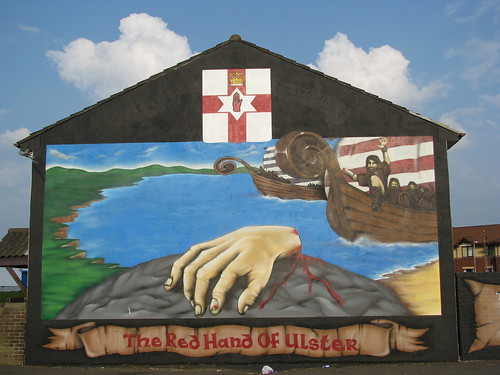
What's worse is that the Israelites were so numerous that they actually created a "hill of foreskins". I tried to find an image of a "hill of foreskins", and unfortunately the only image I came up with was the one pictured above, and a bunch of homosexual photos and some weird reference to "docking", which I won't get into here. Let's just say that some people have way too much time on their hands!
After the men healed, the Captain of Yahweh's angelic host came down to visit Joshua, with a message from the Big Man Himself. "Take off your shoes, Bub, for you are on Holy Ground."
And that's where Joshua, Chapter 5 ends. The Book of Joshua is turning into a rather odd tale, with tales of intrigue, spies, supernatural beings, and a hill of foreskins.
Wednesday, July 28, 2010
Above: The Gilgal Gardens in Salt Lake City. Photo from 15 Bytes
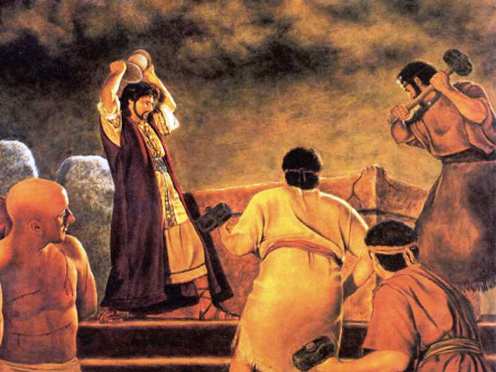
Joshua Builds a Monument to the Israelites Crossing of the Jordan River - At the time that Joshua was written, there must have been some sort of monument, or a peculiar grouping of stones, in the Jordan River and also another set on the banks of it (or not too far from shore).
Those who saw the stones probably wondered where they came from. I say this because the author writes that the stones "are still there unto this day." (Joshua 4:4) This suggests that the book was written well after the fact, and the chapter serves as an explanation for these peculiar stones. By the way, the stones are no longer there.
But according to Joshua, the stones acted as a monument to the Israelites 'miraculous' crossing of the Jordan River. The author even writes that this is the story that should be told to children who come later, asking pesky questions.
After this unusual ceremony and the Jordan River filled back up with water, 40,000 Israelite warriors assembled on the plains of Jericho. Another monument was erected with 12 stones Joshua had taken with him.
Perhaps one interesting correlation with this story, is the story of Moses crossing the Red Sea. Twice Yahweh assisted the Israelites with crossing a difficult body of water. But the situations were completely opposite. In Moses' time, the Israelites crossed a large sea and were fleeing an oppressing army; this time the Israelites were the ones on the warpath.
Wednesday, July 14, 2010
Yahweh Lies to Joshua (Chapter 3) - Chapter 3 is very similar in wording to the last chapters. Yahweh once again promises Joshua, and Joshua reports in 3:10, "He (Yahweh, or God) will without fail drive out from before you the Canaanites, and the Hittites, and the Hivites, and the Perizzites, and the Girgashites, and the Amorites, and the Jebusites"
In essence, this is a lie that will become obvious a few chapters later in the book.
There is one miracle that occurs where the Israelites were able to cross the Jordan River without getting their feet wet. This occurred during their march toward Jericho.
The Israelite priests holding the Ark of the Covenant to lead the column, until they got to the Jordan River. the Israelites would then have to stand 2,000 cubits behind the ark, and make sure they had been properly cleaned prior to their march, etc. As the water receded the priests holding the Ark stood in what was once the middle of the river, while the Israelites continued to the other side of the bank.
Wednesday, July 07, 2010
There sure are a lot of prostitutes in the Bible (Joshua, Chapter 2) - It's no secret that prostitution is one of the oldest professions. There will always be a demand for sex, no matter what legal restrictions are put on it.
In this case, the prostitute becomes a central character in the story, and there's a little foreshadowing to show that she's going to play a part later on as well.
Joshua sent out two scouts to survey the land, and especially Jericho, the walled city. While in Jericho, the scouts went into a harlot named Rahab's house, where they "came in unto her". I'm not sure if this means they had sex with her, or if they just stayed the night. But, it is worded as sex has been worded in previous books, especially with the phrase "came in unto her".
Well Rahab took kindly to these two gentlemen, whether it's because they were good lovers or she really bought into the notion of their god, I can't say. But she did mention that she has heard of their god Yahweh, and that the people in the region fear the Israelites. So, maybe she was betting that Jericho would lose the coming invasion.
Rahab's house was located on a part of the wall surrounding Jericho. She let them rappel down the wall by a scarlet thread. This thread was to remain on her window to warn the invading Israelites not to hurt anyone inside that house, as per an arrangement she made with the two scouts.
So, we got the making for a pretty interesting war story. Scouts meeting with sympathizers inside the walls of Jericho, and the ominous fear being felt by its inhabitants, knowing about the coming invasion. Too bad the authors of Joshua sucked, or perhaps it was the translators. In any case, there are the elements for a halfway decent story to be told here, and whoever wrote it or translated blew it. I wonder, does this mean that Shakespeare was a better author than Yahweh?
Saturday, July 03, 2010
Joshua of Nun (Joshua 1:1) - Immediately after Moses's death, Yahweh looks to Joshua, the Son of Nun. Yahweh (aka the Judeo-Christian God) says to Joshua that He will not fail him, and "every place that the sole of your foot shall tread upon, I will give unto you."
So, let's not bandy about here. In order to be a fundamentalist Christian today, we have to believe the following: the all-knowing, all-powerful Lord of the Universe, Yahweh Himself, is actively taking part of a tribe of desert barbarians wandering about the Mediterranean/Middle Eastern desert, promising them land in His role as an "omniscient real estate agent" (thank Sam Harris for that jewel).
Joshua isn't shy about this at all. He gets right to it, and starts commanding the Israelite tribes. And just like Moses in Deuteronomy, he falls into the same rhythm: "Do as I say and you will get everything you ask for, but if you don't you will be put to death."
Next time, Joshua's spies hump a hooker.
So, let's not bandy about here. In order to be a fundamentalist Christian today, we have to believe the following: the all-knowing, all-powerful Lord of the Universe, Yahweh Himself, is actively taking part of a tribe of desert barbarians wandering about the Mediterranean/Middle Eastern desert, promising them land in His role as an "omniscient real estate agent" (thank Sam Harris for that jewel).
Joshua isn't shy about this at all. He gets right to it, and starts commanding the Israelite tribes. And just like Moses in Deuteronomy, he falls into the same rhythm: "Do as I say and you will get everything you ask for, but if you don't you will be put to death."
Next time, Joshua's spies hump a hooker.
Tuesday, June 22, 2010
Moses dies, couldn't have written Deuteronomy - Many religious people contend that Moses wrote the first five books of the Bible (the Pentateuch) by himself. That can't be, because how could he have written Chapter 34, which is essentially his obituary?
It's a very short chapter, too. Moses dies in Moab and is buried somewhere near Bethpeor, but no one knows where his tomb is (Deut. 34:6).
It says he lived to be 120 years old, and was sharp-witted and able-bodied as ever, which contradicts Chapter 31, which said he was unable to "go out and come in". I'm not sure what Chapter 31 was referring to, but it sounded like it was a big problem for Moses.
The chapter also ends by saying that no prophet in Israel is like Moses, in that he knew Yahweh "face to face". This, of course, contradicts many other verses in the Bible that describe people who actually have seen Yahweh, or the claim that Yahweh can be seen at all. In fact, in Exodus 33:11, Yahweh Himself only shows his ass to Moses and tells him he will never be able to see his face because no man can see His Face and live.
And that ends my foray into the Book of Deuteronomy, and I'm proud to say, I finished reading the Pentateuch. Finally!
Moses does a final shout to his boys - Before he dies, Moses does a shout out to his boys in the leadership caste of the Israelites in Chapter 33. It's not too much really, just the glorious rantings of a dying old man who probably never existed.
One thing that's weird is that in the beginning it says that these are Moses's words, but Moses is mentioned in the list of people being praised. In fact, he's the first one.
Some of the more interesting "props" given is for Levi, and a special compliment for his Urim and Thummim. The Urim and Thummim is kind of like a coin toss. Flip it and it lands, you get heads (or Urim) or tails (Thummim), and that guides the decision.
Another interesting shout-out is to Joseph, who actually gets a lot of praise from Mo. Aside from Joseph being blessed by Yahweh in successful agriculture and hunting his glory is like the first male son of a bull, and his horns are like a unicorn. They really had a different concept for flattery back then, didn't they?
Thursday, June 17, 2010
Deuteronomy 32: Is God Bipolar?- If Yahweh had a psychologist to evaluate Him, it's pretty clear that He'd be diagnosed with a severe case of bipolar disorder. This is of course bad news to His followers.
Chapter 32 starts off nice, Moses talking about how great Yahweh is and how perfect His work is. And then, with almost no transition, it sinks into the macabre. Literally, here's the transition:
32:4 He is the Rock, his work is perfect: for all his ways are judgment: a God of truth and without iniquity, just and right is he.
32:5 They have corrupted themselves, their spot is not the spot of his children: they are a perverse and crooked generation.
And it goes downhill from there - burning and starving for everyone, including elderly and children.
What I want to know is - where does perception of a loving God come from? I mean I see that the Israelites loved Yahweh - well, some of them did. And Yahweh sometimes shows love - but it's a love that's built on conditions. It's not really "love" as we understand it. And it's built on the most ridiculous of conditions - "Believe in me and follow my laws, or else!"
As Deuteronomy, and therefore the Pentateuch, come to a close, I yearn for the great wisdom of the Bible. I haven't seen much evidence for it yet. Deuteronomy especially is just the same thing, over and over: "God is wonderful, but since you guys suck He's going to make your life really shitty!"
Chapter 32 starts off nice, Moses talking about how great Yahweh is and how perfect His work is. And then, with almost no transition, it sinks into the macabre. Literally, here's the transition:
32:4 He is the Rock, his work is perfect: for all his ways are judgment: a God of truth and without iniquity, just and right is he.
32:5 They have corrupted themselves, their spot is not the spot of his children: they are a perverse and crooked generation.
And it goes downhill from there - burning and starving for everyone, including elderly and children.
What I want to know is - where does perception of a loving God come from? I mean I see that the Israelites loved Yahweh - well, some of them did. And Yahweh sometimes shows love - but it's a love that's built on conditions. It's not really "love" as we understand it. And it's built on the most ridiculous of conditions - "Believe in me and follow my laws, or else!"
As Deuteronomy, and therefore the Pentateuch, come to a close, I yearn for the great wisdom of the Bible. I haven't seen much evidence for it yet. Deuteronomy especially is just the same thing, over and over: "God is wonderful, but since you guys suck He's going to make your life really shitty!"
Thursday, June 10, 2010
At 120 years old, Moses begins to worry about his legacy.
Moses prepares to die - In a man's waning years, he becomes worried, perhaps even paranoid, that all of the things that he worked for in this life will go to hell in a handbasket. This is the image I get of the author of Deuteronomy, Chapter 31.
Moses, whom aside from the Bible there appears to be no evidence of being a real person, symbolizes the worries of the ancients who wrote collaborated in the writing of Deuteronomy. They wrote it during a time of competition with other religions. They wrote it as their new Yahwist religion was just getting afoot. The religion had a strong base among the Israelite people, but many people still worshiped the gods of old Sumeria. And so, as the founders of the religion began to get old, they worried. And, they used Moses as the mouthpiece of this worry.
As his strength and vision was leaving him, Moses said he is no longer able to move around. But he told the Israelite people he had a vision, and Yahweh told him that they will conquer the nations around them with the help of Joshua. He brought Joshua before them and told him of the vision.
Yahweh had also wrote a song for Moses. That was rather kind for an all-knowing, all-powerful deity to do, wasn't it? The song further reflected the worries of these old men. Apparently, to set up the need for the song, Yahweh told Moses that after he dies, his people will begin to worship the other gods in droves; and that He (Yahweh) will no longer bless them but curse them.
So, He made a song to teach the Israelites so that they will be ever reminded of Yahweh's love of the Israelites, what He did for them, and what they must do for Him in return.
So, in a nutshell. Whatever this song was (it was unclear in the chapter what the song was), it was made because the Levites (or priesthood) were worried that people were on the verge of losing their religion, and taking on other ones.
What I want to know is if Yahweh was so prevalent back then, showing himself as a great pillar of fire and smoke upon the Tabernacle, making these great shows of display, destroying all their enemies, and even destroying a few Israelites in the process - why is it that so many Israelites had so much trouble believing in Yahweh? Why was it such a prevalent problem that people were converting to other religions?
Thursday, June 03, 2010
Did this gentleman choose to jump up and down at the beach, or is it the Will of God?
Deuteronomy 30 - The Lord thy God will circumcise your heart ..." Thanks, Yahweh. Having all that extra skin on there is a sure way for it to get dirty.
Fortunately, Deuteronomy is quick, dirty, and mercifully short. It's basically the same format as the last few chapters. "If you do what Yahweh says, He'll be happy and bless you. If not ... well, we ought to know by now what that entails." Murder, death, cursing, blah blah.
Long after this book was written, a gentleman named Paul living in the Roman Empire misquoted a part of this chapter to serve his own ends. Deuteronomy 30:14 says, "... the word is very nigh unto thee, in thy mouth, and in thy heart, that thou may do it."
Basically, Deuteronomy 30:14 says that though Yahweh's Law is professed and in our heart, we have the ability to choose to do it.
In the Book of Roman 10:8, Paul wrote: "The word is nigh thee, even in thy mouth, and in thy heart: that is, the word of faith, which we preach." Paul leaves out "that thou may do it" and replaces it with "that is, the word of faith, which we preach."
By doing so, this passage is turned on its head. Now, instead of faith and choosing to do the right thing; Paul is now supporting salvation by faith alone.
Tuesday, May 25, 2010
Meet Maniac, from the Israeli band Mayhem. Photo from BlabberPhotos2 on Photo Bucket.
Briefly, Deuteronomy 29 brings us back to sanity. And it's not sanity like we think of it, it's like when a raging maniac calms down to rest after hacking 30 people into pieces.
Gone are the explicit and descriptive curses that were part of chapter 28. Now, it's more of a yearning. A pleading. Moses says to the Israelites, "You've seen all the great miracles, you're clothes haven't fallen apart after 40 years in the wilderness (yes, it says that), we took the land of so many people for ourselves, and as long as you don't follow other gods, none of the curses in this book will fall on you."
Deuteronomy, which is coming to a close, is a diabolical book. It just is. But I think the author, or authors, got most of the angst out in the last chapter (Chapter 28).
Labels:
deuteronomy 29,
homicidal maniac,
maniac,
mayhem,
psychopath
Wednesday, May 19, 2010
One of the worst punishments for not following Yahweh and the Levite priests' advice: You'll eat your own children! Family value meals! (Deuteronomy 28:53-55)
Deuteronomy 28 is a descent into madness. Here's a basic rundown.
It starts off innocent enough. If you follow Yahweh and listen to the advice of the priests, you (meaning 'the Israelites') will:
- Be blessed in the city and in the field
- be blessed in body, crops, livestock, and family
- have your basket and store blessed
- be blessed when you "come in and when you go out" - not sure what that means
- find that Yahweh will defeat your enemies before you face them (they'll come against you one way and flee seven)
- find that your storehouses have been blessed
- be considered a holy person unto Yahweh Himself
- AGAIN be blessed in body, crops, livestock, and family.
- Have abundant crops due to good weather, other people will borrow from and owe you (not the other way around)
- Be the head and not the tail.
- You will be cursed in the city and in the field
- Your basket and store will be cursed
- Your body, crops, livestock, and family will be cursed
- You will be cursed when you "come in and go out." - still have no idea what that means!
- You will be sent in cursing, vexation, and rebuke in everything you do until you are dead
- You'll get very sick with pestilence
- You'll be smited with consumption, fever, inflammation, "an extreme burning", by sword, "the blasting", MILDEW, and Yahweh will pursue you until you die!!!
- Heaven above will be brass, while the earth below is iron. (On top of all the other stuff, you get crappy weather too!)
- Instead of rain, your crops will get powder and dust.
- Your corpse will be eaten by vultures and other scavengers
- You'll get the botch of Egypt, hemorrhoids, scabs and itches that can't be healed, madness, blindness, and "astonishment of heart" (if numbers 6 and 7 weren't bad enough!)
- You'll grope around during day and night, won't be prosperous (no shit!)
- When you marry, other men will sleep with your wife
- Your ox will be slain before your eyes, your donkeys will be "violently taken away before your eyes", your sheep will be given to your enemies
- Your sons and daughters will be given away to other people; you'll look everywhere for them, but will not find them
- You will not be prosperous at all (how many times do the priests threaten this?), and you will be oppressed by others
- You'll go mad just at the sight of the things going on around you
- Your knees will be smited and you'll get a huge sore botch from the bottom of your feet to the top of your head.
- You'll be ruled by a strange nation and worship their gods, wood, and stone.
- You'll become a joke to your neighbors
- Locusts will consume your crops; worms shall eat your vineyards
- You'll have fruitless olive trees
- You'll have sons and daughters but won't enjoy them because they'll go into captivity.
- The strangers among you will rise up and rule
- You'll serve your enemies hungry, thirsty, and naked, under a yoke of iron, until your dead.
- Yahweh will send a fierce nation from the end of the earth, and this nation will eat your cattle, take the fruit of your land, he'll besiege your city and easily overtake it, and you'll BE FORCED TO EAT YOUR OWN FLESH AND YOUR OWN CHILDREN'S FLESH
- Pretty women around you will turn an evil eye toward husband and eat her children
- Mass plagues will destroy your people
- The Israelites will be scattered around the world and follow other gods
- The Israelites will be sold back to Egypt as slaves.
Labels:
blasting,
bless,
botch,
cannibalism,
children,
consumption,
crops,
curse,
deuteronomy 28,
disease,
eating children,
eating kids,
fever,
locusts,
plague,
smiting,
vineyards,
worms
Wednesday, May 12, 2010
Don't uncover your father's skirt!
Deuteronomy Chapter 27 is another quick chapter. Here's the basic message:
- When you're passing Jordan and going into the land of milk and honey, build an altar of whole stones on Mount Ebal.
- After burning offerings at the altar, write on the stones the following commandments.
- First, Seimeon, Levi, Judah, Issachar, Joseph, and Benjamin should stand on Mt. Gerizim to bless the people.
- Then Rueben, Gad, Asher, Zebulun, Dan, and Naphtali should stand on Mt. Ebal to curse. Who do they curse? I don't know.
- Don't make molten images, or display the works of craftsmen, or put such works in secret places.
- Those who set light by their parents will be cursed.
- Those who remove their neighbor's landmark shall be cursed.
- People who make blind people wander out of the way shall be cursed.
- Anyone who perverts a stranger's judgment shall be cursed.
- Anyone who has sex with their father's wife will be cursed because he "uncovered his father's skirt??".
- Anyone who has sex with an animal ... you guessed it. Cursed!
- Sex with sister, the daughter of his father, or the daughter of his mother. Cursed!
- Anyone who has sex with his mother-in-law shall be cursed.
- Anyone who "secretly smites his neighbor" shall be cursed.
- Anyone who does not confirm these laws is also cursed.
And, isn't a person who causes blind people to wander out of the way simply "an asshole"? Cursing people doesn't do anything.
And how is having sex with the father's wife "uncovering the father's skirt"? Is it because the father's wife is actually the father's property? More than likely!
Rule 15 is the clincher. It hermetically seals the deal. But I would argue that anyone who does not confirm these laws is actually wise.
Labels:
bless,
curse,
deuteronomy 27,
ebal,
father's skirt,
gerizim,
kill the father,
mount,
neighbor's landmark,
skirt
Saturday, May 08, 2010
Don't feed dead people. - Deuteronomy 26:14
Deuteronomy 26 is nice and short, and like the other chapters it's a list of arbitrary rules. Here's basically what it says:
- Give the first fruit of your crops to Yahweh (actually the priesthood). The justification for this: Yahweh brought them out of Egypt.
- Every three years, give more to the poor, the strangers, the priesthood, orphans, and widows.
- Don't eat while in mourning, don't eat for unclean reasons, and don't offer food for the dead.
Labels:
deuteronomy 26,
food for the dead,
killing strangers,
levites,
orphans,
priesthood,
widows,
zombies
Wednesday, April 21, 2010
Deuteronomy, Chapter 25 is another list of arbitrary rules that leave me wondering what situation created a need for them in the first place?
Rule 1. If a judge convicts someone as guilty in a dispute, the judge can issue no more than 40 lashes by a whip. Anymore than that would be publicly humiliating.
Rule 2. Don't muzzle an ox while he's working; in other words, let the ox eat while it works.
Rule 3. When one brother dies, his wife must marry his brother (whether she likes him or not?). It says, "If brethren dwell together, and one of them die, and have no child, the wife of the dead shall not marry ... her husband's brother shall go in unto her, and take her to him to wife, and perform the duty of a husband's brother unto her." A husband's duty, according to this passage, was just to have sex with his wife.
Rule 4. If the MAN doesn't want to have sex with his brother's wife, then the wife should go to the elders, remove the man's shoe, and spit in his face. Huh?
Rule 5. When two men are fighting, and a wife helps her husband by grabbing the other man's balls, then she should have her hand chopped off. What?!?
Rule 6. Be honest when doing business with others.
Rule 7. Hate the Amelekites.
Okay, so in Deuteronomy Chapter 25 the rules are all over the map, and they're all arbitrary. The one rule that is actually halfway decent is the sixth one I list above, which is Deuteronomy 25:13-15, about not cheating when doing business with others. Letting an ox eat while it works is nice, but I'd be inclined to say its unimportant. And the other stuff, stopping at 40 lashes, hating the Amelikites, chopping a woman's hand off for protecting her husband, is just wrong. And weird!
Thursday, April 15, 2010
Deuteronomy 24 is fun, because it is weird. There is no unifying message behind this chapter, except maybe advice on how to resolve disputes. I think.
1. The first lesson is about divorce and remarriage. If the man doesn't like her for some "unclean" reason, he can divorce her and then she can remarry. But if the second husband doesn't like her for some "unclean" reason, then the first husband CANNOT take her back. I wonder what situation occurred where such a rule should ever even be addressed?
2. The second lesson is that a newly wed man can not go to war or be bothered with business matters. He has to spend the whole year trying to make his wife happy.
3. Anyone who steals slaves should be executed.
4. Do what the priests tell you to do, or you'll get leprosy. That's an awesome rule, and such a guilt trip!
5. Don't oppress the poor, whether they be slaves or just poor. That's actually a decent rule!
6. You shouldn't kill the father for the crimes of the child, and vice versa. This is such a good rule, but it contradicts other Biblical teachings that the criminal's progeny should be punished. That's the whole concept of original sin, isn't it?
7. Finally, the last rule is to treat kindly strangers, orphans, and widows; and share whatever you have with them. Another nice thing to practice.
In summary, we went from divorce and marriage; to treating strangers kindly. And there isn't a real thread of unity between the two subjects. I think that this document was an attempt to legislate random occurrences that just happened. But the solutions are so arbitrary and don't really solve the problem, or are just completely ignorant.
1. The first lesson is about divorce and remarriage. If the man doesn't like her for some "unclean" reason, he can divorce her and then she can remarry. But if the second husband doesn't like her for some "unclean" reason, then the first husband CANNOT take her back. I wonder what situation occurred where such a rule should ever even be addressed?
2. The second lesson is that a newly wed man can not go to war or be bothered with business matters. He has to spend the whole year trying to make his wife happy.
3. Anyone who steals slaves should be executed.
4. Do what the priests tell you to do, or you'll get leprosy. That's an awesome rule, and such a guilt trip!
5. Don't oppress the poor, whether they be slaves or just poor. That's actually a decent rule!
6. You shouldn't kill the father for the crimes of the child, and vice versa. This is such a good rule, but it contradicts other Biblical teachings that the criminal's progeny should be punished. That's the whole concept of original sin, isn't it?
7. Finally, the last rule is to treat kindly strangers, orphans, and widows; and share whatever you have with them. Another nice thing to practice.
In summary, we went from divorce and marriage; to treating strangers kindly. And there isn't a real thread of unity between the two subjects. I think that this document was an attempt to legislate random occurrences that just happened. But the solutions are so arbitrary and don't really solve the problem, or are just completely ignorant.
Labels:
deuteronomy,
divorce,
husband,
kill the child,
kill the father,
leprosy,
marriage,
oppression,
slaves,
treat kindly,
wife
Thursday, April 08, 2010
Deuteronomy, Chapter 23 has more sets of obscure rules. Here they are:
Preserving the Male Genetic Line
1. A man whose testicles are injured must not be admitted into the congregation of Yahweh.
2. Bastards (male children without fathers) cannot be admitted into the congregation of Yahweh.
3. Moabites and Ammonites may never be admitted into the congregation of Yahweh, even later generations.
4. But the third generation of Edomites and Egyptians can be admitted into the congregation of Yahweh.
5. Any male who has a wet dream is unclean until the evening (and after he's washed himself).
These four rules seem to be geared toward assuring that the male Israelite genetic line is preserved. Men with injured testicles cannot reproduce and bastards can not carry their family line. Wet dreams, I'm not sure but I suppose they thought it was 'unclean', which I suppose it is. But to wait until nighttime to come back to the camp?
The Moabites and Ammonites dared to go to resist the Israelites, but the Edomites are the descendents of Esau, who was the brother of Jacob, one of the founders of the Israelite people. So, the logic is that the Edomites are technically related to the Israelites.
The mercy to the Egyptians follows different reasons, though. It is because the Israelites, even though they were in captivity by the Egyptians, were "strangers in their land." Maybe someone else can explain the reasons in that one.
DooDoo-Ronomy
So that Yahweh doesn't step in human feces, it is advised in Deut. 23:12-14 to carry a shovel with you and poop outside of the camp. Some people call this Doodooronomy. This raises an interesting question, did the Israelites think Yahweh has a physical body that can actually step on crap?
Freeing the Slaves
Here's a nice rule. Deuteronomy 23:15-16 says that if a slave runs away from his master, the Israelite shouldn't return the slave, but rather let him stay with him in his house.
Intolerance in the Bible
Whores, Dogs, and Sodomites shouldn't be allowed inside the house. Whores and Sodomites I understand; but dogs? Dogs is the Israelites' derogatory word for homosexual. Essentially, it's like saying, "Don't let those flaming faggots live in your house!"
Labels:
ammonites,
deuteronomy 23,
doodooronomy,
edomites,
egyptians,
faggots,
flaming,
gays,
genetics,
homosexuality,
moabites,
patriarchy,
slavery,
sodomites,
whores,
Yahweh
Thursday, April 01, 2010
Here are some more rules as laid out in Deuteronomy, Chapter 22. Notice how they get more morbid as they progress.
- Look out for your brother's animals and keep them harm.
- Transvestites are an abomination.
- If you come across a birds nest, you can take the eggs and the chicks, but not the mother.
- When you build a house, make sure the roof is strong.
- Don't wear garments of mixed fabrics (i.e. cotton and linen).
- Don't plow with an ox and a donkey together.
- You should put fringes on your clothes.
- If your wife isn't a virgin on her wedding day, take her to her father's doorstep and kill her.
- Adulterers should be executed.
- If a woman is raped in the city, and doesn't cry for help loud enough, she should be executed.
Labels:
abomination,
adulterer,
adultery,
brother's animals,
deuteronomy 22,
donkey,
execution,
fringes,
mixed fabrics,
ox,
rape,
stoning,
virgin,
wife
Wednesday, March 24, 2010

Deuteronomy's Chapters 19 through 21 deal with what sort of killing is okay in the eyes of Yahweh.
Dealing with the Difference Between Murder and ManSlaughter
Chapter 19 is a sort of amendment to the Sixth Commandment: Thou shalt not murder.
First, anyone that kills his neighbor should be executed. Specifically, he ought to be killed by the victim's closest relative, whom the ancient Hebrews called 'the avenger of the blood'.
If he accidentally kills someone, then the accidental killer must flee to another city. But, if he returns to the city where the victim lived, then the 'avenger of the blood' may kill the guy.
However, before determining this there should also be three witnesses.
Killing in the Context of War
Deuteronomy, Chapter 20, if I can sum it up, says that first of all the Hebrews should not be afraid in battle because Yahweh has their back.
The chapter makes a distinction between two types of foes: distant enemies that are too far to be conquered, and nearby enemies that can be incorporated into the Israelite nation. Upon defeating distant opponents, Israelites should slay all the males but take for themselves all the cattle, children, and women for themselves.
But closeby cities, which Yahweh has essentially given to the Israelites, are to be utterly destroyed. Yahweh instructs the Israelites to kill all the lame, sickly, and elderly people; but to take young women and children.
In fact, as Chapter 21 explicitly says, if you find a beautiful woman among the captives, take her into your house, shave her head, let her mourn her dead parents, and then "go in unto her".
An ancient Israelite can even have two wives: "one loved, and one hated."
When Punishment Deserves Death
Chapter 21 even talks about what sort of infractions deserve death.
In particular, any child who is disobedient, and I mean thoroughly disobedient, then he should be taken to outskirts of the village and stoned to death by the villagers.
And if the punishment is hanging, the advice given by the author of Deuteronomy is that the person should be taken down before the end of the day. Apparently, the criminal who was hung is so vile that if he remained on the tree for more than one day, his vileness would contaminate the land.
Labels:
19,
20,
21,
avenger of the blood,
conquest,
deuteronomy,
execution,
killing children,
looting,
polygamy,
prisoners of war,
punishment,
rape,
stoning
Monday, March 22, 2010
Thursday, March 18, 2010

In my many conversations with apologists, Bible thumpers, and the extremely pious; I've found that the most effective way to "win" starts off by showing that the argument for a) the existence of god, and b) the god they believe in, require completely different proofs. Former apologist John Loftus writes about it in his blog 'Debunking Christianity' as well. Numerous nonbelievers, like Sam Harris, successfully use the same strategy.
The Proof for Deism
Arguing for the existence of god is called "natural theology", or deism. This god relies on gaps in scientific knowledge. We should have no problem on a practical level with this. Until those gaps are filled, this god will always exist. So, arguing against deism is basically useless because either way it won't matter.
The Proof for Christianity
But Christianity is something completely different. Christianity does not rely on gaps in scientific knowledge. It relies specifically on whether the Gospel accounts of miracle stories attributed to Jesus are true. Just establish this obvious distinction first.
Soon, I will place another post up for the next step, which is simply the basic argument for why we should reject Christianity. But if you want to watch a short version of it, here's how Sam Harris did it at the La Ciudad de las Ideas debate earlier this year.
Tuesday, March 16, 2010

I just read Deuteronomy, Chapters 17 and 18. Again, we are covering ground that has already been covered. And in some cases, we're covering ground that I'm not sure should be covered.
The lessons I've learned in Chapter 17 are:
- Kill people who deconvert or follow other gods.
- Don't sacrifice animals with blemishes.
- When being judged by a priest, I must follow his judgment and if not I will be executed.
- When under the power of the king, the king should not have multiple wives.
- The king should also not have too much money.
- The Levite priests can't own land, and must live off the offerings of the other tribes.
- Sacrifice the firstfruit of my crops and my livestock.
- Anyone that practices witchcraft (unless it's magic from Yahweh, of course) is an abomination to Yahweh.
So, Yahweh plans on sending prophets. He also warns against false prophets. Unfortunately, the only way to tell the difference is if their words come true. And if they don't, they are to be executed.
Being a Prophet is serious business for the ancient Israelites.
Labels:
17,
18,
abomination,
animals,
bllemishes,
deuteronomy,
firstfruit,
levites,
other gods,
sacrifice,
witchcraft
Wednesday, March 10, 2010
Deuteronomy Chapter 16 - In this chapter we are reminded about some of the special holy days set aside by the ancient Israelites. In particular, there are three great festivals in which Jews and Israelites should meet at the temple and celebrate.
The Feast of Unleavened Bread is celebrated during the month of Abib, which is a month in the Hebrew calendar. It's to remind the Israelites about their escape from Egypt. In 16:3 it says that you must eat unleavened bread for seven days; and in 16:8 it says six days, so I'm not sure what that's about.
The Feast of Weeks is meant for the entire community of ancient Israelites, and it is to remind them that their people were once bondsmen of Egypt.
In this chapter, it's not clear what The Feast of Tabernacles is about, but elsewhere on the web it says it's agricultural in origin.
During these festivals, or holidays, the males of the tribe must present themselves before Yahweh, and give a generous donation to the priesthood.
I'm not sure why it's in there, but at the end of the chapter (16:16), it almost sounds like judges and officers are picked during these festivals as well.
It's an interesting chapter and there's nothing too controversial. It's actually interesting to learn about the holidays of other cultures as well.
The Feast of Unleavened Bread is celebrated during the month of Abib, which is a month in the Hebrew calendar. It's to remind the Israelites about their escape from Egypt. In 16:3 it says that you must eat unleavened bread for seven days; and in 16:8 it says six days, so I'm not sure what that's about.
The Feast of Weeks is meant for the entire community of ancient Israelites, and it is to remind them that their people were once bondsmen of Egypt.
In this chapter, it's not clear what The Feast of Tabernacles is about, but elsewhere on the web it says it's agricultural in origin.
During these festivals, or holidays, the males of the tribe must present themselves before Yahweh, and give a generous donation to the priesthood.
I'm not sure why it's in there, but at the end of the chapter (16:16), it almost sounds like judges and officers are picked during these festivals as well.
It's an interesting chapter and there's nothing too controversial. It's actually interesting to learn about the holidays of other cultures as well.
Labels:
booths,
deuteronomy,
feast,
feast of tabernacles,
feast of weeks,
unleavened bread
Tuesday, March 02, 2010

Deuteronomy Chapter 15 tackles the troubling issue of poverty and slavery. I think it has some nice things to say about poverty.
15:7 says, "If there be among you a poor man ... thou shalt not harden thine heart, nor shut thine hand from thy poor brother."
And 15:11 says, (15:11)"Thou shalt open thine hand wide unto thy brother, to thy poor, and to thy needy."
Yes. That's great advice! It still sounds good to this very day. Would you agree?
And then there's slavery.
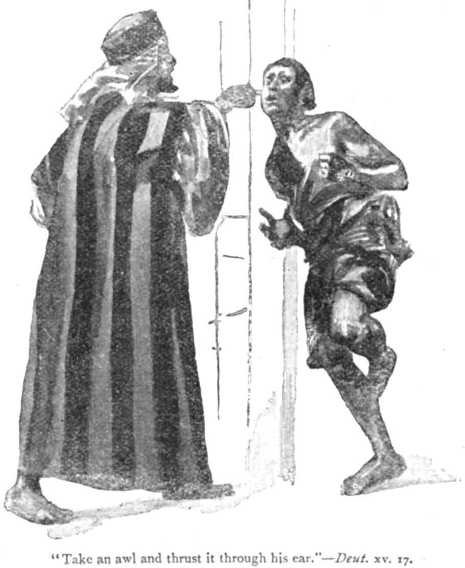
15:12-17 says, "If thy brother, an Hebrew man, or an Hebrew woman, be sold unto thee.
and serve thee six years; then in the seventh year thou shalt let him go free from thee. And when thou sendest him out free from thee, thou shalt not let him go away empty: Thou shalt furnish him liberally out of thy flock, and out of thy floor, and out of thy winepress: of that wherewith the LORD thy God hath blessed thee thou shalt give unto him. And thou shalt remember that thou wast a bondman in the land of Egypt, and the LORD thy God redeemed thee: therefore I command thee this thing to day. And it shall be, if he say unto thee, I will not go away from thee; because he loveth thee and thine house, because he is well with thee. Then thou shalt take an aul, and thrust it through his ear unto the door, and he shall be thy servant for ever."
Basically, after a slave's seven year term, hook him up and be generous to him as he parts ways. If he/she wants to stay with you, drill a hole through his ear into a door and he'll be your servant for life.
Judging from a modern-day perspective, more than 2,000 years later, a perspective with the hindsight of the Civil Rights era, the American Civil War, and the various practices of slavery before then; slavery has been a big moral issue for humanity. It's still a big issue today; and the arguments even delve into what is called wage slavery - which is basically what everyone calls "working". Anytime another human's labor is owned, and not purchased in any way, that raises the question of slavery and whether it is moral.
But 3,000 years ago when Deuteronomy was written, nobody in ancient Israelite society had these conversations (or at least published them).
So I ask you, the reader, this: What is it that makes it possible for people today to pick up the Bible, read Deuteronomy Chapter 15, and see that one set of passages are moral, and another set isn't?
Labels:
deuteronomy,
morality,
poverty,
slavery
Monday, February 22, 2010
Dennis,
Click here
Out of sheer coincidence, nonstampcollector just put this up today and describes what I'm trying to explain to you in cohesive manner.
Click here
Out of sheer coincidence, nonstampcollector just put this up today and describes what I'm trying to explain to you in cohesive manner.
Labels:
dennis,
morality,
nonstampcollector,
out of context

Deuteronomy, Chapter 14 is instructions on how to create an ancient Israelite restaurant.
But first - a bit on how restaurant staff should look. Sorry emo people, God doesn't want you to cut yourself. And you guys and gals with uni-brows, you can't shave them! And you DEFINITELY can't do neither for the recently deceased!
Another important distinction to make about the Bible is to not take its scientific claims seriously, like in 14:7 where Moses instructs the Israelites not to eat "the hare, and the coney: for they chew the cud."
Just an FYI, rabbits don't chew their cud. They eat, poop, and then eat their poop, which is what they digest.
So yes, no rabbits on the menu! And no sea creatures that do not have fins or scales (i.e. mussels and clams). And there's a whole litany of birds that will not be on the menu; they're mainly predatorial birds like eagles and pelicans; but there's also those pesky swans and bats. Bats!?! Yes, the ancient Israelites had no concept of grouping animals by mammalian characteristics. At least, there methodology wasn't sophisticated enough to tell a flying mammal from any other bird. To them, animals were grouped by flying and nonflying, divided hooves or not, sea creatures with scales and fins and those that didn't; and 'clean' and 'unclean'.
The ancient Israelites didn't necessarily think these animals were dirty. By 'unclean', they were either talking about whether the animals was fit for animal sacrifice; and that is usually determined on whether the animals fit neatly into their primitive methodology of categorizing the world.
Also on the menu is roadkill, or any dead animal found laying around. Ancient Israelites couldn't eat these things because they weren't ritualistically cleaned when the animal died (they weren't 'kosher'), but they were instructed to have no qualms about selling this to outsiders. I wonder, if there was such thing as an Ancient Israelite restaurant, would the waiter tell the infidel guests that the food they were eaten was from an animal they found lying in the street?
Oh yes, and don't ask for a baby goat to be boiled in its mother's milk. They don't do that!
Friday, February 12, 2010

"If there arise among you a prophet, or a dreamer of dreams, and giveth thee a sign or a wonder ... that prophet, or that dreamer of dreams, shall be put to death." Deuteronomy 13:1-5
Under this law alone, many people would have been put to death. John Lennon, Spinoza, Isaac Newton, Moses, Jesus ... all guilty of being either a prophets and dreamers if judged from the eyes of the ancient Israelites. Luckily, these eyes are long closed.
Deuteronomy, Chapter 13 is a sermon to the Israelites on the evils of new ideas, aka heresy.
A few verses later (13:6-10) Moses spells it out clearly: ""If thy brother ... or thy son, or thy daughter, or the wife of thy bosom, or thy friend, which is as thine own soul, entice thee secretly, saying, Let us go and serve other gods ... Thou shalt not consent unto him ... neither shall thine eye pity him ... But thou shalt surely kill him; thine hand shall be first upon him to put him to death, and afterwards the hand of all the people."
Today of course, we ignore all of Moses' advice in this chapter, but I must ask you. If the Bible is a manual for morality, what is it that causes us to ignore this verse but find wisdom in a verse like that in Leviticus that says to "Love your neighbor."?
Labels:
deuteronomy,
dreamer,
kill thy neighbor,
Leviticus,
love your neighbor,
moses,
prophet,
sign,
wonder
Wednesday, February 03, 2010

Destroying Altars
Okay, I was a bit misleading last time. Yahweh doesn't ask the Israelites to drink the blood of animals, rather he asks them to a) sacrifice an animal, b) pour the blood out all over the altar, and then c) eat the flesh. Satan probably wasn't invented yet, but Satanists (the devil worshipping kind, not the 'atheist' kind) today might recognize the ritual as one of their own.
Moses also instructs the Israelites to go out and completely destroy the altars and groves of the nations surrounding them. He's basically trying to shore up Yahweh as the only god for the Israelites. This violent backlach against other religions suggests that these other religions were a bit of a problem for the budding Yahwists. It seems feasible at least that at least a few Israelites were a little too interested in the religions of their neighbors, and the political infrastructure of Israelite society wanted to stop this curiosity.
In the words of Moses (Deuteronomy 12:30), "Take heed to thyself that thou be not snared by following them, after that they be destroyed from before thee; and that thou enquire not after their gods, saying, How did these nations serve their gods? even so will I do likewise."
Moses then brings up the human sacrifices of their neighbors as a reason not to follow them. Which is odd, because this is the same society that has no problem executing disobedient sons, women who had sex before their wedding day, and killing the children of the nations they conquer (or should I say, "happily dashes the little ones on the rocks?).
I'm getting this weird picture here. And it goes soundly with the principle that "History is written by the conquerors." The Israelites were a sort of rogue militaristic nation amongst many other similarly cultured Sumerian/Canaanite nations. It was the Israelites who had the strongest drive to go out and conquer their enemies. These other nations didn't put up a very good resistance either.
Some might say it's because Yahweh was on their side. I'd have to disagree. It might've 'seemed' like Yahweh on their side, in the same sense finding an empty parking space in front of Walmart might seem like God reserved it just for you. But I think the Israelites were just a lot more organized then their neighbors. They had a great propaganda machine going on. And they probably had a charismatic leader. Then again, it's also quite likely that a lot of this is early stuff about Israel is legend. Many scholars don't even think Moses was real; but I'm sure that some cult leader was responsible for the upstart religion/nation.
A lot of what is said in the Book of Numbers and most of the Pentateuch isn't supported by archaeology, either. The places might correspond, but the events as they are recorded in the Bible don't match up (like millions of people wandering the wilderness).
Anyways, the Israelites continue to have problems with other religions until the later 'reformist' kings begin their rule. Right now, Deuteronomy is trying to describe a time when the Israelites were just getting a foothold in the region.
Next time, we'll discuss why Yahweh nor the Israelites would not have liked John Lennon much.
Friday, January 29, 2010

Hindsight is 20/20, and if I was in the crowd whom Moses is talking to in Deuteronomy 11, and knew what I know now, I'd have to call Moses out on his b.s. Of course, I'd probably be stoned for blasphemy, too.
Chapter 11 is basically an appeal to the Israelites, and it can be summed up real quick. Follow these commandments that I give you; and you will be blessed. Don't follow them; your life is going to suck.
Even if I'm trying to be sympathetic to these guys in the Old Testament, I can't. It's just so easy to see through their facade. This is really just politics of fear. "If you're not with us; you're against us."
But that's cool, I have read this in the past, but not as critical. Now, as I read the Bible I am increasingly amazed that people think this is the "greatest book of all time," especially when it is most emphatically NOT. Shakespeare is better than this. Hell, reading Hegel's ramblings on the Zeitgeist is better than this!
But still I trudge on. Next time, Yahweh asks the Israelites to drink blood during their sacrifices.
Sunday, January 24, 2010
Friday, January 22, 2010

I've mentioned before that Deuteronomy is a collection of sermons from Moses to the Israelites.
Deuteronomy, Chapter 8 is a reminder to the Israelites that if they forget Yahweh for what He has helped them achieve, then He will chastize them.
As the closing sentences say, "And it shall be, if thou do at all forget the LORD thy God, and walk after other gods, and serve them, and worship them, I testify against you this day that ye shall surely perish. As the nations which the LORD destroyeth before your face, so shall ye perish; because ye would not be obedient unto the voice of the LORD your God."
Chapter 9 is a sort of pep rally to the Israelites just prior to invading other lands. Moses warns the Israelites of "nations greater then their's" and of even MORE giants! But they shouldn't fear, because they have Yahweh on their side, and the Ark of the Covenant, and they shall surely prevail.
Moses justifies their invasion. I paraphrase this, but I encourage you to the chapter for yourself. "It's not for our own pride or for our own benefit, but because these nations are an affront to Yahweh, and it is only through their destruction that Yahweh can deliver on his Holy promise of delivering them to their land of milk and honey."
Moses reminded the people about how they have strayed. "While I was up on the Mount for 40 days and 40 nights, eating only bread and water, and Yahweh was writing His commandments, you were down here worshipping an idol of Ba'al, and corrupting yourselves! Yahweh wanted to destroy you then, but I interceded and convinced Him not to do so."
In Chapter 10 Moses continues his historical narrative, basically reminiscing on the how the ark of the covenant was created. He sort of takes the credit for building the ark. But if we look back in Exodus 37:1, it's a man named Bezaleel. Moses also seems to get it wrong about the death of Aaron and where he was buried. In Deuteronomy, Aaron was buried in a place called Mosera; but in Numbers Aaron was buried on Mount Hor.
Moses closes chapter 10 with a series of problematic statements. He says that the only requirement he asks of the Israelites is that they fear Yahweh, to keep His commandments, and to remember that the heavens and the earth belong to Him. We should be kind to strangers, praise Yahweh because he is above all other gods, and we should swear by His name.
There's so many technicalities on that little bit. Depending on where you read in the Bible, the Earth belongs to either God, humans, or the devil. Being kind to strangers isn't necessarily a Judeo-Christian trait if you've read the Bible. And of course, we're not supposed to swear by the name of this particular god.
We see here in these chapters that Yahweh can be reasoned with, if we stroke His ego. Wait. Isn't that the key to all Abrahamic religions? Isn't that what Jews, Christians, and Muslims say that the whole purpose of life is? It's to worship. It's to stroke the ego of Yahweh, or Allah. Worship is that, and it is also a surrender to God. Right?
I remember when I was a Christian. The words I spoke were meant to stroke the ego of God, but the experience in so doing was a surrender. There's nothing wrong with the surrender, per se. It's the context of how we do it that is problematic. The surrender is an experience that can be had by all humans. Surrendering of course, leaves us in a vulnerable state. The words that we say in this condition, be it "Praise Jesus", "Hare Krishna", "Om nama shivaya" or "Allahu Ackbar" are utterly separate from the experience itself. It is only afterward that we internalize the meaning of these words. We somehow attribute their implications to the spiritual experience itself. If you don't believe me, try it yourself.
So, in the words of Moses, "Don't be so stiff-necked and proper. Rather, circumcise the foreskin of your heart." (Deuteronomy 10:16) :)
Tuesday, January 12, 2010
Above: Hey, they were only doing what they thought God wanted them to do.I like Deuteronomy, Chapter 7. There's so many things wrong with it - historically, intellectually, and ethically. There's even a little bit of prophecy in there.
Yahweh's prophecies were that 1) the Israelites will conquer seven great nations (Canaanites, Amorites, etc.), and 2) that the Israelites (and their cattle!) will NEVER become infertile. Later on, in Joshua, we find that the Yahweh was simply unable to deliver on the first prophecy. And of course, people of Hebrew descent have the same rate of being barren as any other human.
Historically, this chapter implies that there was more than 20 million people in the region at this time. The archaeological evidence does not support that at all. In fact, anyone that thinks the Bible is inerrant is just plain wrong.
Intellectually, there are a few contradictions:
1) Yahweh tells the Israelites not to intermarry with these other tribes. Moses, of course, is an exception.
2) Yahweh also instructs the Israelites to kill strangers; but a few chapters later in Deuteronomy 10, Israelites are asked to be kind to strangers "because they were strangers in Egypt."
And ethically, this chapter is just a nightmare. It advocates:
1) The killing of strangers who worship a different god.
2) Killing all of the inhabitants (including women and children) of the lands they conquer.
3) Intolerance (don't intermarry, destroy relics of the other people's religions, etc.)
So, that's Chapter 7 in a nutshell. I wonder what an apologist would say? That it's okay in that cultural context and that time period?
Monday, January 04, 2010
Above: An image from www.thebricktestament.com, a young man posts the Law on his gates to keep the Law strong in Israelite society.After going over the Second Commandment in Chapter 4, Moses reviews all of the Commandments in Chapter 5, and then in Chapter 6 he talks about how to keep the law going. This is basically what Deuteronomy seems to be: a series of sermons from Moses to the Israelites. It's like the pastor's playbook.
In the first three chapters, they reviewed their time in the wilderness. More information was added to it then in Exodus and Numbers. They fought a lot of giants, and conquered off a lot of Canaanite tribes, for example. Now, Moses is reviewing the Commandments with a little more depth, and it's written more like a sermon.
"... when ye heard the voice out of the midst of the darkness, (for the mountain did burn with fire,) that ye came near unto me, even all the heads of your tribes, and your elders ...", sounds like Moses is talking directly to people.
And I think I've already laid out the problems with the Ten Commandments (i.e. women are property, it's okay to own slaves, punishment doesn't fit the crime, etc.).
Chapter 6 is another sermon from Moses, and it is about how to keep the law going strong in Israelite society: which is basically to remind everyone about it and keep talking about it. It sounds like something the Communists were famous for, and what EVERY society does: good ol' fashioned propaganda.
Except, instead of talking about the revolution, or democracy, or freedom; the Israelites were concerned about keeping the Law. What steps did they take? Here's the rundown:
1. Teach it to the children.
2. Talk about it in the privacy of your home or out in public, when sitting, lying down, or standing up.
3. Bind copies of the Law to your hands and on your head.
4. Put it on door posts and to the gates of your house.
Perhaps the last two seem extreme, but we've seen it. The Red Star or the American flag hat; the Che Guevara poster on the wall. The Israelites can be said to have been the first people to record this behavior.
Next time, we discuss bad archaeology in Old Testament.
Labels:
che guevara,
communist,
democracy,
deuteronomy,
freedom,
moses,
propaganda,
sermon,
the law
Tuesday, December 22, 2009
If the Commandments were in order of importance, this would be the second most immoral thing you could do.Deuteronomy, Chapter 4 - once again Yahweh brings up the Second Commandment. "When thou ... make a graven image, or the likeness of any thing, and do evil in the sight of the Lord, you shall perish upon the land and be utterly destroyed."
I'm trying to understand this irrational paranoia about the graven image. While I'm convinced the punishment is ridiculous, I kind of understand what the authors were trying to get at. A graven image isn't the thing itself, or the 'ding an sich'. It's merely a representation of something.
So, a drawing of a bird, for example, is nothing more than a manmade representation of a bird. It's obviously not the real thing. Apparently, to the ancient Hebrews, this was a problem.
Since they were the descendents of Sumerians and Canaanites, it's quite likely that a lot of Israelites still held on to the beliefs in other gods within the Sumerian/Canaanite pantheon. And they probably had a lot of idols to represent each of these gods. The Israelite priesthood, who was really trying to get this Yahweh thing off the ground, decided that the best way to deal with this was to ban graven images entirely.
The Catholic Church, a 1000 years later, approached the subject with a different strategy. Instead of banning idols, they simply incorporated their own images to substitute the idols of various barbarian tribes. The Catholic saints are usually the replacement of various pagan gods. For example, St. Nicholas replaces the Greek god Poseidon.
I'm inclined to believe that the Catholic Church's tactic was a little more successful. It incorporated more people, and it didn't alienate them at all.
Tuesday, December 15, 2009

In Deuteronomy, Chapter 3, Moses and his band of Israelites take on yet ANOTHER giant! This time, he's the king of the Bashanites; a man named Og.
While his name sounds like he's nothing more than a primitive caveman, and his nation sounds like a violent gang (the Bashingites?), Og is apparently the last of the race of giants. I think that's the Israelite priests' gimmick; portray Moses as the Giant Slayer.
Sure enough, we get another wonderful pearl of wisdom in Chapter 3: "And we utterly destroyed them, as we did unto Sihon king of Heshbon, utterly destroying the men, women, and children, of every city. And we utterly destroyed them ... utterly destroying the men, women, and children, of every city. But all the cattle, and the spoil of the cities, we took for a prey to ourselves."
Now, since Og was a giant, he was obviously no pushover. According to the narrator, Og was 9 cubits high! That's like 13 feet high! Shaq ain't got nothin' on him. Og's bed along was 13.5 feet long and six feet wide!
Moses later comforts Joshua with a little pep talk. He essentially says, "You saw how we breezed through those two kingdoms so easily. You serve an awesome God. What OTHER god is there that could kill so many people?!?"
Next time, God promises to utterly destroy anyone who creates ANY graven image!
Labels:
bashan,
bashanites,
deuteronomy,
giant,
giants,
joshua,
moses,
nephilim,
og,
sihon
Thursday, December 10, 2009

Above: A giant from Greek mythology, the Cyclops. Isn't it likely that giants were a regular subject in ALL ancient mythology?
Well, let me just say that I'm very excited to be finishing up the Pentateuch. As I started reading the first two chapters of Deuteronomy I noticed that this book seems to be written more as a letter to the Israelite people, from Moses, and basically just recounting what they did.
In Chapters 1 and 2, it almost seems like there's a lot of repetition going on. In Chapter 1, Moses talks about killing the Amorites and their king, a group of giants called the Anakims, and about the faithless cowardice of the Israelite people.
I find the talk of giants to be interesting. There were quite a few tribes apparently. There was of course the Nephilim, whom we learned of previously. But there was also the Anakim, the Emim, the Avims, and the Caphtorims - all of which lived in different areas.
For some reason, Moses talks about the strange arbitrary choice to let the Moabites and Ammonites live in peace, but kill off people like the Amorites, which we learned of in Numbers. He even "hardened the heart" of the King of Sihon, just so the king would come out and fight the Israelites and give the Israelites a good reason to kill of his people. That's crazy talk!
To quote the author of Deuteronomy, ""And the LORD our God delivered him before us; and we smote him, and his sons, and all his people. And we took all his cities at that time, and utterly destroyed the men, and the women, and the little ones, of every city, we left none to remain."
Tuesday, December 01, 2009

I'm finally going to finish Numbers here. I've been at this book for what seems like months. After all the huffing and puffing, animal sacrifices and censuses, the Israelites send 12,000 men to battle against the Midianites. The Midianites are obliterated, and every Midianite male is killed.
The Israelites take the Midianites' livestock and goods, and bring the surviving women and children to Moses. Moses is shocked, and says, "Why did you bring back ALL the women alive?!? Kill every male child, and kill every women who has had sex with a man! But all the female children that haven't had sex, keep them for yourselves!"
If you don't believe me, that's Numbers, Chapter 31:17-18.
After this proclamation, the Israelites inventory all the goods they've pillaged. It comes to:
- 675,000 sheep
- Threescore (a "score" is 20, so I'm guessing the total amount here is 72,000) and 12,000 "beeves"
- Threescore and 1,000 donkeys
- 32,000 virgin women.
And I'm not sure where these came from, but they also received an additional:
- 330,500 sheep (of which over 600 were sacrificed)
- 36,000 beeves (sacrificed threescore and 12)
- 30,500 donkeys (sacrificed 61)
- 16,000 persons (It reads as if they may have sacrificed 32 people here.)
This is the main event, but the next few chapters have a few interesting things as well, aside from the constant recordkeeping of where the Israelites move to and set up. It's also good to know that the journey from Egypt to Canaan (where the Israelites eventually wind up), for some reason they were lost for 40 years, when it would've taken a few weeks even back then. Yahweh apparently curses them to wander because the Israelites were discouraged at the sight of the land He had promised them.
In Chapter 33:50, Yahweh tells Moses to kill all the inhabitants of Canaan and make sure to destroy all their religious symbols - melt their statues and take down their 'high places'. High places is probably a reference to the Asherah's, or groves, in which the Canaanite people worshipped Asherah - who in Canaanite and Sumerian mythology is the wife of El. And El, the chief sky god of the Canaanite and Sumerian pantheon, is who Yahweh was originally (in Genesis). Pretty crazy stuff, eh?
"Yahweh" tells the Israelites to kill ALL the Canaanites, or otherwise He will make the Canaanites a thorn in the side of the Israelites. Yahweh my ass. The political leaders of Israel are using Yahweh to justify the killing of the Canaanites. This crap has been going on for thousands of years!
The rest of the chapters are just a bunch of divvying up of the spoils of war, a few begats, and a few extra rules. And that's pretty much it for Numbers - a truly horrific, and horribly written, book of the Bible.
I will close with this interesting rule from Numbers 35:16-28, which I will sum up: "If you kill a person with malice, you shall be put to death. But if it is an accident, you will be safe within the haven of the city. But if you are caught outside the city walls, it is okay for the closest relative of the victim to kill you."
Wednesday, November 25, 2009
Numbers, Chapter 25: Right off the bat, 24,000 Israelites die of a horrible plague. And all this after we've been talking about talking donkeys and the conquests of other nations! What happened?
Well, if you've been following this blog or are familiar with the Old Testament, we all know how Yahweh is. He's jealous, He's psychotic, and He's kind of anal. He almost reminds me of Kim Jong Il.
In a nutshell, the Israelites started hanging out with the wrong crowd; the Moabs and the Midianites. The Israelites even partook of some of the worship ceremonies of the Moabs, who worshiped a god (or Baal) named Peor. Peor is the name of the mountain where they were, so it's likely that Baal Peor was a local god of that particular mountain. Apparently, the Israelite men were getting busy with the Midianite women as well.
Yahweh witnesses this and just goes off the handle. He says to Moses, "Take all the heads of the people, and hang them up before the LORD against the sun, that the fierce anger of the LORD may be turned away from Israel."
As a further affront, an Israelite man brings a "Midianitish" woman before the congregation, and takes her into a tent. The grandson of the recently deceased Aaron sees this, grabs a spear, and pursues the two into the tent, and runs both of them through. In fact, the woman is stabbed through the belly.
Yahweh sees this and is greatly pleased, and prevents the entire population of Israelites from contracting the plague He had sent out. Unfortunately, 24,000 do die before this happens. Yahweh tells Moses that the man who killed the two will be blessed for his zealousness. And then the Sumerian god who nowadays Christians revere as the omnipotent creator of the universe turns to Moses again and says, "Vex the Midianites, and kill them all."
I am happy to report that the next few chapters I can pretty much skip, because they repeat things that have already been said. They go through another census as they prepare to make war on the Midianites (numbers are probably inflated), they go through some more rituals about animal sacrifice, there is another reference to the practice of scapegoating, etc. The only thing to add is that in Chapter 30 we find out that women are not really responsible for anything - it's the men who oversee them that are responsible for them. And if she is responsible for something, it's only because her father or husband allows her too.
Next time, the Midianites gets smited!!!
Above: Heavy metal culture has brought back Ba'al into something completely different.
Tuesday, November 17, 2009

Last time, we discussed the Israelites conquest of the Amorites - which was more like bloody massacre. Numbers, Chapter 22 is about the Moabites.
After witnessing the aftermath of what the Israelites have done, the Moabites are understandably afraid of these new people who have come from Egypt. In response, the Moabites sent a delegation of princes to the nearby land of Pethor, to enlist the help of a wizard. It doesn't actually say "wizard", but I guess that's what he is.
"Balaam, please come to Moab and lay a curse on the Israelites. Those guys are friggin' crazy! They just slaughtered off the Amorites!!!" said the messengers. Oh yea, don't go looking for those exact words in the Bible - I'm just adding a little spice.
Balaam apparently also worships Yahweh, and tells the delegation to spend the night while he consults Yahweh's opinion on the matter. Yahweh, who modern-day worshippers insist is all-knowing, asks Balaam, "Who are these guys that are with you tonight?"
Balaam explains the situation, and Yahweh tells him that he shouldn't curse the Israelites, because they are blessed. The next morning Balaam explains to the princes why he can't go with them.
In response, the Moabites send even higher ranking princes with gold and silver to purchase Balaam's skills. He invites the delegation to spend the night while he consults Yahweh again. This time, Yahweh says, "Look, go ahead and go with them if they call on you. Just do what I tell you to do."
So, the next morning Balaam gets on his donkey and follows the princes back to the land of Moab. But for some reason, this gets Yahweh angry! "And God's anger was kindled when he left ..." That's what it actually says! Yahweh just told him to go with them, and then gets pissed when Balaam does just that!
An angry Yahweh sends an angel to block his path (apparently the princes were not with him on the road to Moab). Yahweh does this three times, and three times Balaam strikes the donkey for trying to go around the angel. It would seem that the donkey is more reasonable then Balaam, unless you realize that only the donkey can see the angel. And the angel doesn't seem to intent on stopping them, either. He just stands in the path, and Balaam and the donkey goes around him.
On the third time, the angel is standing between two walls and there's no way past. So, the donkey lays down and Balaam strikes the donkey for the third time. The donkey looks back at Balaam, open his buck-toothed mouth, and says, "Why the hell do you keep hitting me, man? Can't you see I'm trying to avoid running into one of the Almighty's soldiers?"
And finally, Balaam sees the angel.
Anyways, Balaam finally gets to Moab, where Yahweh apparently "puts a word in his mouth".
Balaam tells the Moabite royalty basically that Yahweh's on the side of the Israelites, and that He sent him to bless the Israelites; not curse them. "Yahweh's not just some man, he's a god, and He brought the Israelites out of Egypt," said Balaam. "Yahweh's got the strength of a unicorn."
A unicorn?!? Unicorns are pretty strong, I'd imagine; but omnipotent? Or is Yahweh just pretty strong? If that's the case, that explains why Jacob was able to beat Yahweh in a wrestling match.
Balaam continues, "Behold, the people shall rise up as a great lion, and lift up himself as a young lion: he shall not lie down until he eat of the prey, and drink the blood of the slain."
So now the Moabites realize that not even their precious magician Balaam is on their side, so they try one last negotiating trick. "Well, how about if you neither curse them or bless them?"
Balaam probably threw his hands up and said, "Hey, Yahweh wants me to do it. What can I do?"
And so, in Chapter 24, Balaam blesses the people of Israel. He concludes the blessing, "God brought him forth out of Egypt; he hath as it were the strength of an unicorn: he shall eat up the nations his enemies, and shall break their bones, and pierce them through with his arrows. He couched, he lay down as a lion, and as a great lion: who shall stir him up? Blessed is he that blesseth thee, and cursed is he that curseth thee."
The Moabites are pissed, but the deed has been done.
Next time, Yahweh kills 24,000 Israelites!

Tuesday, November 10, 2009

Massacres and maladies in the service of the Lord. That's what Numbers Chapter 21 is all about. An apologist might argue that this chapter is about the great things that can happen if you put your trust in Yahweh.
In a nutshell, what happens is the Aradites find out that the Israelites are coming. An ancient Paul Revere must have ridden through the town, saying, "The Israelites are coming! The Israelites are coming!"
The Israelites must have had a pretty bad reputation by this point, but they haven't done much massacring - yet - except to their own people of course. But we're talking about Bronze Age desert tribes - they were all pretty damn barbaric. We could hypothetically judge them by our modern morality, but we'd just be missing the point.
After learning about the Israelites march on Arad, the Aradites pull a "Dubya" and opt to act "unilaterally" against the Israelites with a preemptive strike. They are initially successful, and even take a few prisoners.
Man, that pissed off the Israelites! They pleaded to Yahweh, "Hey Lordy, if you deliver these people (the Aradites) to us, we will utterly destroy their cities." (Numbers 21:2)
Of course, Yahweh loves that kind of talk, and did just as they asked! "He delivered up the Canaanites, and the Israelites utterly destroyed them and their cities." (Numbers 21:3)
Now, the Isrealites have also had a history of whiners (check out some of my previous posts). After taking out the Aradites, they go back to their wandering ways, trying to find their "Promised Land". Naturally (for them), they start whining. These guys don't get it, do they? And it's the usual complaints that anyone would have - no food, no water, blah blah blah.
In response, Yahweh sends poisonous "fiery serpents" against the Israelites, and many of them die. As usual, Moses beseeches Yahweh to stop this violence.
Yahweh then does something that contradicts the Second Commandment. He tells Moses to build a bronze serpent and put it on a pole. "Everyone who looks upon this serpent will live," says Yahweh.
Remember the Second Commandment, "Thou shalt not make unto thee any graven image, or any likeness of anything that is in heaven above, or that is in the earth beneath." (Exodus 20:4) Well anyways, by breaking the Second Commandment, the surviving snake bitten Israelites live.
An apologist might defend this by saying that Yahweh's making the order, so it's okay. And everyone else in the world would say that's a lame argument for morality.
A little later, at Numbers 21:14, we come across one of the lost books of the Bible. It mentions The Book of the Wars of the Lord; which is basically an account of all the Israelites battles, from the Red Sea up to the point that Numbers was written. Hey, that's pretty cool if you're a War Nerd like me (or Gary Brecher)!
After this, the Israelites just go on a string of massacres; this time against the Amorites. It roughly the same formula -the non-Israelites try to do a preemptive strike, and they lose against the Israelites - suffering a massacre and the destruction of their cities; and the subsequent occupation of these cities and their outlying villages by the Israelites.
Finally, after all that excitement, the Israelites massacre one last nation before we put Chapter 21 to rest; the Bashanites. Yahweh tells the Israelites not even to worry about these pushovers. "I have delivered him into thy hand, and all his people, and his land; and thou shalt do to him as thou didst unto Sihon king of the Amorites, which dwelt at Heshbon." (Numbers 21:34)
So they smote him, and his sons, and all his people, until there was none left him alive: and they possessed his land.
Next time, we discover Mr. Ed's ancient precursor. But this time, it's a talking donkey!
Tuesday, November 03, 2009

The Israelites discover an interesting way to qwell a rebellion: give 'em what they want.
A few significant things happen in Numbers, Chapter 20. Miriam dies, Aaron dies, another rebellion occurs, and the Kingdom of Edom refuse to give the Israelites passage through their kingdom.
To sum it up, on the way to the land of milk and honey (aka "the Promised Land"), the Israelites have pass through the desert of Zin. There is no water, and so the people begin complaining again. This time, they know what's going to happen, but in their words, they'd rather die by Yahweh's hand then to die of thirst.
After consulting with Yahweh, Moses comes back with an interesting tactic to qwell the rebellion; give 'em what they want. Yahweh told him to gather the congregation and basically impress them by making water come from a rock.
Moses gathers the congregation and yells out, " Hear now, ye rebels; must we fetch you water out of this rock?" And then he taps the rock twice and a fountain of water shoots out. Everyone is happy; except Yahweh. Yahweh is pissed! You see, Yahweh told Moses to simply speak to the rock; not hit it.
And for this transgression, Yahweh tells Moses and Aaron that they won't be able to see the promised land. Sucks for them. But still, the people didn't get slaughtered off, and that's a good thing.
Well, they continue on their journey and find they have to cross the kingdom of Edom. Edom does not allow them to pass, even after some reasonable bartering on the part of the Israelites. In fact, Edom sends out his army to make sure the Israelites don't pass. And so the Israelites have to go around.
The Israelites come across Mount Hor. At this mountain, Yahweh says that Aaron will die here. He tells Aaron to go up the mountain a ways, and Moses is to take off Aaron's clothing, and put the clothing on Aaron's son. They take off Aaron's clothes, put them on his son, and Aaron dies, presumably butt naked, on the mountain.
As we can see, this is starting to sound like Greek mythology, of sorts. Yahweh is acts like a Greek god or goddess. Sure, He's one god, as opposed to many. But in this one god, we have the traits that stand out in any god at that period of time. Yahweh isn't a vague mysterious deity; He's personal and He's very emotional, and He's definitely got some MAJOR character flaws. Talk about touchy!
Next time, the Israelites massacre two cities and have yet another rebellion, and this time Yahweh qwells the rebellion with snakes.
Labels:
aaron,
aaron's son,
Greek,
miriam,
moses,
mount hor,
rebellion,
water of meribah,
Yahweh
Subscribe to:
Posts (Atom)